
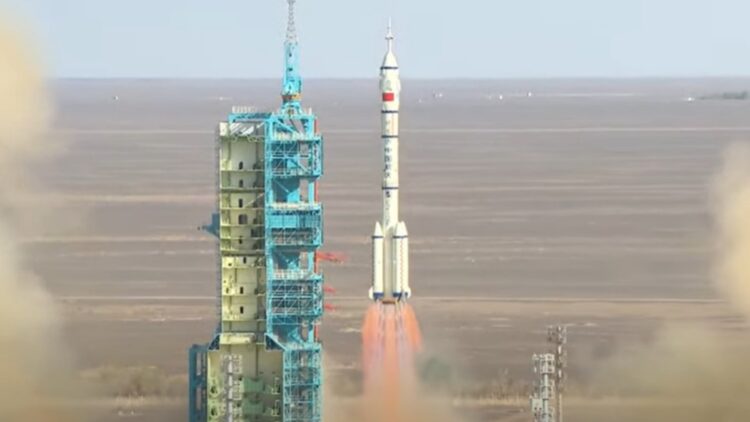
China has just done something totally unprecedented in space, which is launching an empty rescue spacecraft to bring back the Chinese astronauts who are on the Tiangong station. Not for whim, obviously, but because of a pretty serious emergency in which microcracks were found in the capsule that was supposed to bring them home, probably caused by space debris…
As soon as the problem was discovered, alarms went off in Beijing. The mission planned for 2025 was moved up six months and, in a matter of days, Shenzhou 22 was in orbit, ready to become the crew’s “lifeboat.”
Tiangong, we have a problem
It all started when the astronauts of Shenzhou 20 noticed several microcracks in a window of the capsule. Hundreds of kilometers from Earth, understand that any small failure is a very big failure.
Experts attribute the cracks to the impact of small fragments of space debris, pieces of objects or rocks that orbit out of control and can travel fast. When impacting, they could have made that capsule unusable to return to our planet.
For ten days, the situation was quite delicate. If something had gone wrong and any failure had occurred, there was no quick way to evacuate anyone. For China, it was the first time that a real threat put the crew at direct risk because of the orbital environment.
Shenzhou 22
Seeing the risk, the Chinese government did not hesitate and scheduled an early launch. They rewrote the calendar and launched from Jiuquan a Long March 2F/G with a completely empty spacecraft and one mission: to become a rescue capsule.
Once in orbit, Shenzhou 22 docked flawlessly with Tiangong, which brought peace of mind back to the entire team. This will be the capsule used by the astronauts who arrived at the end of October with Shenzhou 21.
And what happens with the damaged spacecraft?
Interestingly, they are not going to discard it. China plans to leave it in orbit for a while longer to use it as a scientific platform, although it is no longer useful for returning, something like leaving even more space debris up there.
A space program
This scare does not change the country’s plans. China has spent years accelerating its space program and achieving its first milestones, the landing of Chang’e 4 on the far side of the Moon, the arrival of Tianwen-1 on Mars, and the continuous deployment of modules and missions to keep Tiangong functioning.
And the space debris?
Well, it is something they will have to find a solution for because orbit is becoming more and more saturated, and that will only make space missions increasingly complicated…
Although NASA and other organizations are already thinking of solutions for this problem, this chapter of space exploration has set off all the alarms about the debris orbiting above our heads. Is it normal that we have polluted space as much as our own seas?!
The key: reacting fast
China does not usually show such drastic changes in its plans, and that is why this early launch caught so much attention. Its ability to react, reorganize a crewed launch and execute it in days shows that the space program is already at a very mature level and that perhaps there will soon be many more advances…
What comes next for the Tiangong station
With Shenzhou 22 ready as an emergency capsule, the astronauts will be able to return to Earth in April without any added risk. Until then, they will continue with their experiments and scientific routines.
Tiangong, the cornerstone of China’s space future
The station is key for China’s permanent presence in space. And every incident like this, even if it is not desirable, serves to improve designs, preparations, protocols and the resistance of future missions.