
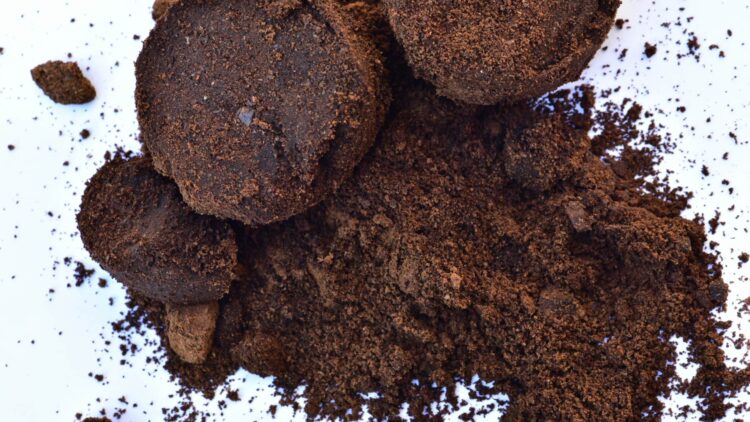
If you are one of those people who makes a big cup of hot coffee every morning to get going on the day, but then you never know what to do with the leftover coffee grounds… We are here to tell you that there is nothing we like more than a trick with the three “R’s”: recycle, reduce and reuse!
Every year more than 10 billion kilograms of coffee are produced in the world, an enormous amount that also produces the same amount of organic waste.
When we use coffee, what remains in our coffee maker is called “grounds”, these grounds, in addition to taking up space, release greenhouse gases, such as methane… But now, thanks to “pyrolization”, coffee grounds can become a very powerful tool that can change our cities towards a more sustainable world.
What and who is researching?
A group of scientists from RMIT University in Australia is investigating how to give a new twist to this waste, and they have managed to turn it into a key material for construction, giving a second life to this compound that would go directly to the landfill.
What is pyrolization?
Here we go! This process tries to transform waste into resources, an incredible innovation. This technique consists of heating coffee grounds at high temperatures (more than 350ºC). This would turn coffee grounds into “biochar”, which is a substance with unique properties that is very rich in carbon and acts as a great water absorber. And what are they going to do with this?
Very easily, in certain quantities, the strength of this material increases by 29.3% compared to conventional concrete, so we would be talking about a new, more resistant type of cement.
As we already know, both concrete and cement are practically irreplaceable materials in today’s construction, we find them in every built place we can imagine. As a material, we cannot doubt its quality, but we can doubt the environmental impacts it causes (the extraction of sand, the use of water and other resources leave a large ecological footprint to produce this concrete.
Alternatives to concrete are scarce, which is why this new technique with coffee has drawn so much attention from the community, because it does present itself as a great alternative.
What are the real benefits of using coffee grounds?
As you can understand, this process goes far beyond simply recycling coffee. The environmental impact of this innovation is very interesting, because by reusing them instead of throwing them away, methane emissions are reduced (which are a greenhouse gas 21 times more potent than carbon dioxide). On the other hand, the need to extract sand (which affects coasts and rivers) is also reduced and a circular economy model would be created, so that materials are used to reduce waste and the use of non-renewable resources.
Not only would this help combat the climate crisis we face, but it would also offer a very sustainable solution to meet the demand for construction materials.
What does circular economy mean?
The so-called circular economy is a production model based on the reuse of resources, that is, on minimizing the waste that we humans produce as much as possible.
In this case, coffee would be transformed into a component for construction (closing the life of the material that was previously directly discarded).
This does not mean that only the construction industry will benefit, but it could open the door for other sectors (such as livestock or wood) to also be a little closer to a more sustainable future.
Is the future sustainable?
There are still many tests to be carried out, such as evaluating durability under extreme conditions or checking that it is really worthwhile to carry out this process, but, for now, it seems that the future is going to change a lot the way we build our cities! What seemed like waste could now be what transforms the entire industry. Isn’t it incredible?
I’m sure you’ll think about this the next time you drink a hot cup of coffee and go to throw the grounds in the trash!