
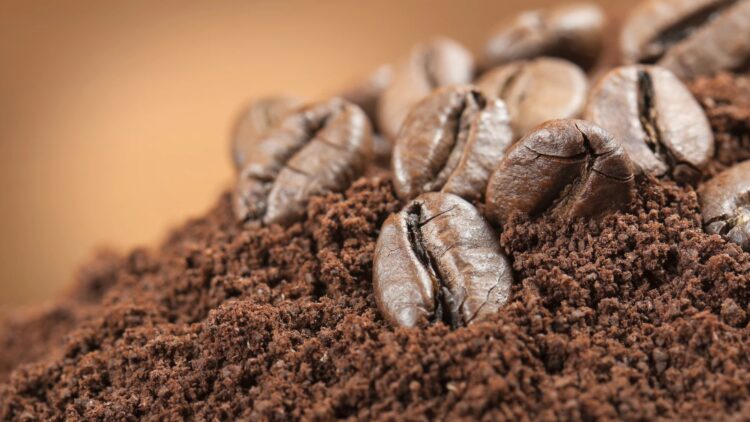
In this article, we are going to talk about a discovery made by Australian scientists: coffee grounds can become a helpful material to make concrete stronger. The idea seems shocking, but it actually has 2 important benefits: help reduce waste that harms the environment and the amount of sand needed in construction, since sand is becoming harder to obtain because the construction industry uses so much of it. So, let’s learn more about this Australian discovery.
The issue with coffee grounds
Every time someone prepares a cup of coffee, they might find those coffee grounds. When millions of people have a coffee everyday, these coffee grounds accumulate in great amounts. For example, in Australia about 75,000 tons of these coffee grounds are wasted and most of them end up in landfills. When they decompose, methane is released, which is a gas that contributes to climate change.
This is an environmental issue because what seems small and with not much importance becomes a massive waste that pollutes the planet.
The solution
A group of engineers from the RMIT University in Australia found a solution to use those coffee grounds. They discovered that the coffee waste could become a material to strengthen concrete, so no more coffee would end up in the trash. This helps in 2 ways: reduces the amount of polluting waste and the need to mine so much sand.
According to the study, the secret is in heating coffee grounds through a process called pyrolysis, which transforms them into a material similar to carbon but with a special structure called biochar.
Coffee can’t be added directly to concrete
It’s important to understand that coffee grounds can’t be added directly to concrete because they weaken the concrete. This happens because the organic substances in the coffee interfere with the chemical reactions that make concrete hard and strong. So the researchers needed to find a way to change the structure of the coffee grounds first, so that they could be added without causing problems.
Pyrolysis
This process means to heat coffee grounds without oxygen to remove the substances that weaken the concrete, and leave a light and stable structure. For this, two temperatures were tested: 350ºC and 500ºC. With a 350ºC temperature the resulting biochar improved the concrete and made it almost 30% stronger. But when the temperature was 500 °C, the particles became too fragile and caused tiny cracks in the concrete. This means that the correct temperature is important. Heating at 350 °C creates biochar that has a porous surface, which helps it combine well with the cement inside the concrete.
Use of coffee ground in construction
This is very beneficial because it allows replacing part of the sand used in concrete. The sand is a natural resource extracted from rivers and beaches, and this action damages ecosystems. So, by replacing part of the sand with biochar, the environmental impact is lower.
What’s more, the biochar improves concrete’s inner structure making it more compact and more resistant.
Future of the project
Researchers believe this technique can be applied at great scale. If this is done, it would be possible to use all coffee grounds in Australia to produce concrete, reducing pollution and sand mining. Also, they point out that the process is not expensive and that it can be done with the technology we currently have.
However, they need to find out more about how this concrete behaves with the passage of time and in different conditions, like humidity or temperature changes. It is great to see that more projects are having in mind the environmental impact, isn’t it?