
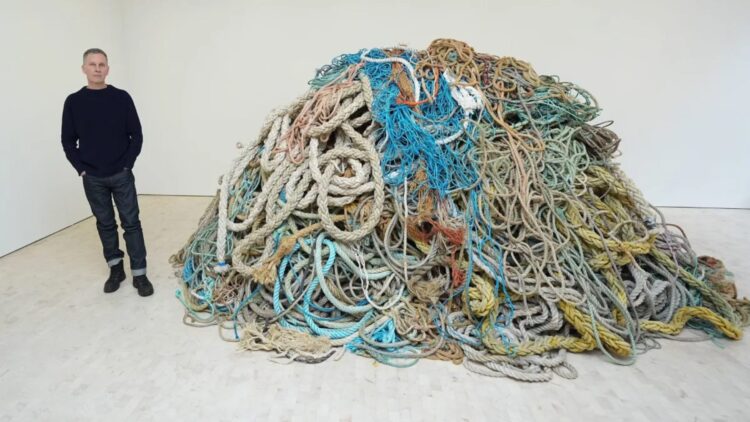
David Shrigley is a British artist known for his curious and surprising ideas, and today we are going to talk about one of them. Sometimes the world of art shows projects that are weird, fun, or even difficult to understand. In this case, David Shrigley spent 8 months collecting something around the UK until obtaining 10 tons of it. Then, he took it to a London gallery to sell it for more than a million pounds.
Sure, this might seem strange, but the aim of the artist is to make people think about why some things considered simple can become art and have so much value. So, let’s talk a bit more about David Shrigley’s piece of art.
Who is David Shrigley?
David Shrigley is an artist known for a humoristic style and for creating art to make people think. For the project we are going to talk about, he decided to do something only a few people would imagine: collect used ropes all over the country. So, for 8 months he asked for ropes that were useless or about to be thrown away.
The aim was to collect 10 tons of used rope, something that seems more of a crazy mission than a traditional art project. However, David Shrigley had an idea behind all of this that comes from the English phrase “money for old rope,” which means earning money very easily or with very little effort. Basically, David Shrigley made that phrase a reality by collecting old rope and selling it as art.
The artist states that the most important part of the project is selling all that rope on sale for more than a million pounds. For him, that sale moment is the final phase of the piece of art.
A project to think about the value of art
David Shrigley’s project is more than a simple mountain of rope, he wants people to wonder about something fundamental: why are some ideas considered valuable and others aren’t?
To explain this, the artist talks about a very popular and controversial piece of art: a banana duct-taped to a wall by Maurizio Cattelan, which sold for more than six million dollars. If a banana on a wall can be considered valuable art, Shrigley suggests that 10 tons of old rope can also make people think about art and what we choose to value.
Shrigley describes his work as “non-aesthetic,” meaning that it isn’t meant to be traditionally beautiful. But even so, when you see all the rope together, it becomes something interesting to look at. It has shape, texture, and presence. For the artist, the rope stops being trash and becomes a fascinating object. With his usual humor, he even says his artwork is a great deal because “pound for pound, or kilo for kilo,” it offers very good value.
What an experience
The piece of art can be seen at the Stephen Friedman Gallery, located in Mayfair, a very elegant area in London. There, visitors can walk among the huge amounts of rope that are full of knots, twists, and tangled shapes. It feels a bit like a maze made entirely of old rope.
The experience can seem strange, curious, or even relaxing. Each person can interpret it in a different way, and that’s the magic of contemporary art: there’s more than just one way of seeing it.
David Shrigley admits that he could earn money more easily if he focused only on painting, but he says that’s not why he makes art. For him, art is supposed to create conversations, questions, and new thoughts. And with this project, he clearly achieves that. Do you agree with him?