
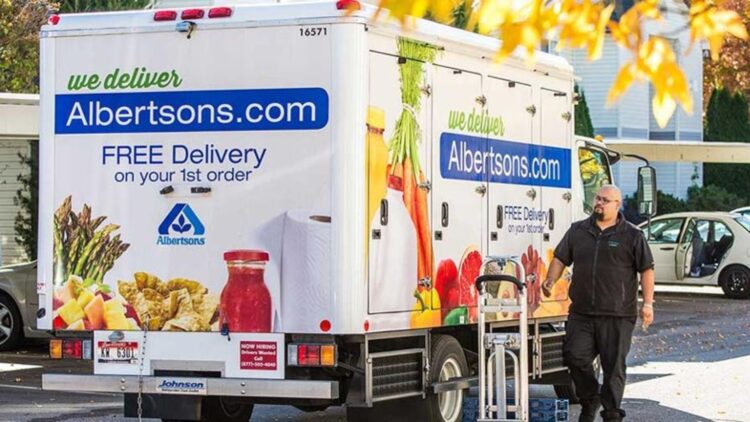
The supermarket world in the U.S. is going through a strong competition. Many big companies are offering faster delivery services, special prices, or advanced technology; all of this to attract customers. In this context, Albertsons, a major grocery chain with thousands of stores across the country, is trying to be at the same level as Walmart or even surpass it. So, let’s see what Albertsons is coming up with.
Albertsons’ ultra-fast delivery service
Albertsons, which has more than 2,200 stores in the U.S., wants to continue being a strong choice when it comes to supermarkets. To make this possible, the company started in September 2023 a service called ‘’flash delivery’’ and ‘’flash pickup’’. The idea is that customers can receive their purchases in 30 minutes or less, depending on the amount of products they order.
The company explained that now 95% of households in the country can use this service, so almost everyone living near one of their stores can receive groceries extremely quickly.
When the service first began, around 2,000 stores across Albertsons brands — including Safeway and Vons — already had it available. After that, the company continued expanding access to even more locations.
How much is it?
Even though the company promises 30-minute deliveries, there are some details we should mention. As we said before, the delivery time depends on the number of goods you order: if you buy up to 35 products, the delivery might be between 30 and 50 minutes instead of less than 30 minutes.
Also, there are extra costs. The flash delivery costs about $11.95, while the flash pickup is $3.95. However, people who have FreshPass, which is the Albertsons’ subscription service, enjoy these services for lower prices (around $2). FreshPass also offers free standard deliveries for orders over $30 and other benefits, like monthly credits, discounts on private label items, and even a special Starbucks perk. If you are interested in FreshPass, its cost is $99 per year or $12.99 per month, almost the same as the Walmart+.
Now that so many customers can get their groceries delivered in less than an hour, Albertsons hopes to attract many more people who value convenience and quick service.
Albertsons and artificial intelligence
Albertsons is also going through an important digital transformation. The company’s CEO, Susan Morris, explained that Albertsons is introducing artificial intelligence (AI) in the entire organization. The goal is to improve how the company works and how customers shop.
One of the new tools is Ask AI, launched in the fall. It helps online shoppers search for products and discover items they might want to buy. Albertsons said that this tool has already led to a 10% increase in basket size, meaning customers are adding more items to their carts when they use it.
What’s more, Albertsons is planning on using generative AI to reduce labor costs, create better employee schedules, and improve forecasting. This should help make sure the right number of workers are available when customers need help.
Walmart, another major competitor, recently warned its 2.1 million employees that they should prepare for major changes in their jobs because of AI. This shows that artificial intelligence is becoming a big factor across the entire retail industry.
Competition and delivery impact
While Albertsons advances with its ‘’flash delivery’’, Walmart and Amazon are also reacting very fast. Walmart made important changes on its delivery service after Amazon launched an “ultra fast” option. All these companies are trying to win customers by promising the fastest possible delivery times. It has become a race to see who can bring groceries and household items to customer doorsteps the quickest.
Kroger and Albertsons
In 2022, Kroger and Albertsons proposed a merger worth $24.6 billion. If approved, it would have been the largest supermarket merger in history. The companies argued that joining forces would help them compete better against huge competitors like Walmart and Costco.
However, the U.S. government disagreed. The Federal Trade Commission (FTC) argued that the merger would harm consumers by reducing competition in many communities, which could lead to higher prices. In September 2024, the FTC asked a judge to temporarily stop the merger.
On December 10, 2024, a judge officially blocked the deal. The next day, Albertsons announced it would exercise its right to end the agreement, meaning the merger was completely cancelled.
So…
Overall, the competition between Albertsons, Walmart, Amazon, and others continues to grow, especially as they race to deliver groceries more quickly and more conveniently than ever before.