
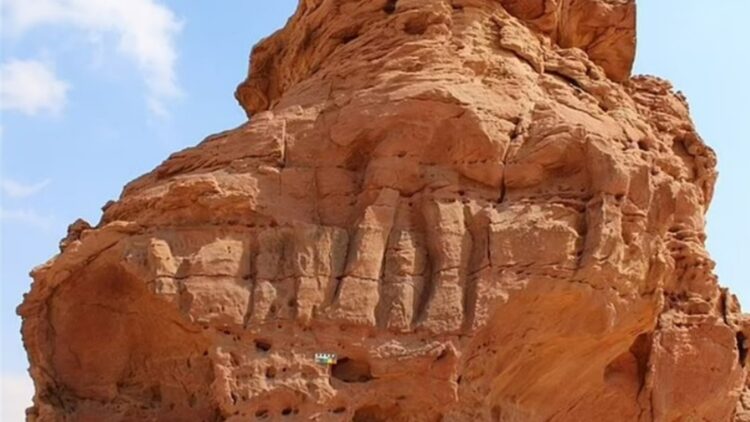
About 12,000 years ago, on a cliff in the north of the Arabian Peninsula, a group of settlers left some drawings on the rock. They did everything with very primitive tools, but managed to capture the figure of life-size camels in the stone. Until now, it was not known if they were decorations, drawings, a pastime or what, but science has shown that they were a sign, the sign that there was water. Yes, the settlers of those lands wanted to indicate where seasonal lakes and water sources formed (remember that the Arabian area is all hostile and arid) and thus they could easily remember where they could find water to survive in a rather complicated environment.
Engravings that were much more than art
The research was published in Nature Communications, and shows that those reliefs served as a visual communication system, like a map or a beacon. Archaeologists located more than 176 engravings in three different areas: Jebel Arnaan, Jebel Mleiha and Jebel Misma.
Of them, 130 represent large animals, mainly camels, but also ibex, wild donkeys and gazelles, some artists! Some of these figures exceed three meters in length and two in height, so you can imagine what it meant to carve these figures in hard rock, with difficult access and with the tools of more than 12,000 years ago…
The landscape of 12,000 years ago
At that time, Arabia was not only desert, between 10,000 and 6,000 years ago, the region was much more humid and fertile and it is believed there were grasslands where today we only see sand and aridity. Of course, the Neolithic herders of the time used these lands for their livestock.
But these engravings mark a transition, the moment when the first communities learned to take advantage of seasonal lakes after the end of the last glaciation.
What appeared under the rocks?
Excavations showed that under the panels arrowheads, stone beads, seashell ornaments and an engraving tool were found. Everything they used to make these engravings!
Thanks to this evidence, researchers were able to date the figures with the luminescence method and confirm their age, about 12,000 years. And indeed, those who made these engravings did not live isolated or were nomads, they formed a cultural network that was connected with communities located up to 400 kilometers north, in the Levant region.
What does the camel mean?
As we told you at the beginning of the article, they marked ancient lakes and places where water was available. The camel is (and was) a symbol of resistance and life in the middle of the deserts, so they used it as a standard to show that water would allow their communities to continue in the future.
Resistant to erosion
These engravings in the Nefud desert are proof of Arabian rock art, and although wind and sand have almost erased them after millennia of erosion, those engravings are still telling us their story, the story of a people who did not give up even though the climatic conditions were not the best.
The reading here is easy, right? Surviving has always depended on ingenuity and the ability to adapt, anything else is throwing in the towel.