
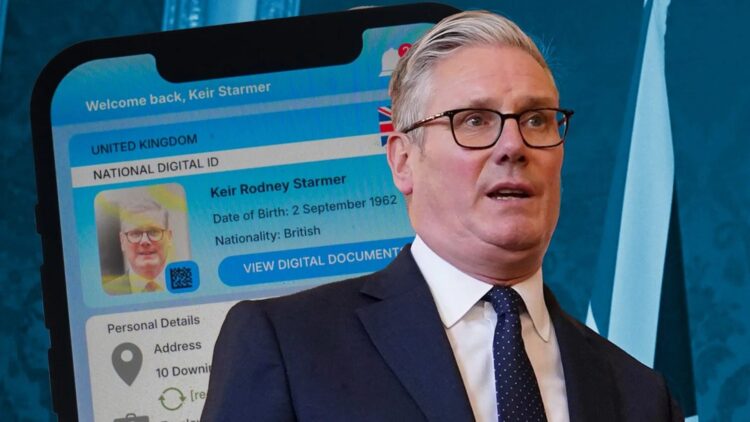
Prime Minister of the UK government, Keir Starmer, has announced a new identification system that will be compulsory in order to legally work in the country. Basically, every legal resident will receive a digital identification before the end of the current Parliament, which could last until August 2029. So, if you are interested in working there or you know someone who is thinking about it, this article is perfect!
What Starmer says about digital identification
For Starmer, this digital identification is more than a control tool, it’s an opportunity to modernize the United Kingdom. “Digital ID is an enormous opportunity for the UK,” said Starmer. “It will make it tougher to work illegally in this country, making our borders more secure. And it will also offer ordinary citizens countless benefits, like being able to prove your identity to access key services swiftly – rather than hunting around for an old utility bill.”
In other words, Starmer defends that this system will help reduce illegal work and, at the same time, ease citizens’ lives when they need to prove who they are.
How digital identification works
The government explained that digital identification is saved in mobile phones, like part of a digital wallet that will also include other documents such as driving license.
For those who couldn’t use a smartphone, Starmer stated that there will be other alternatives because elderly people, homeless or those who can’t easily access technology are also taken into account.
What’s more, the government clarified that it won’t be necessary for everything. For example, it won’t be required for the National Health Service (NHS) or receiving benefits, although those who want to speed processes could perfectly use it.
For working, not for daily life
Culture secretary, Lisa Nandy, explained that everybody is obliged to have a digital ID. However, you won’t have to constantly show it as if it were a physical ID because: it won’t be asked on the street nor when going from one city to another, but it will be necessary when an employer asks for proof about your right to work.
Currently, to work in the UK, workers tend to show a ‘’stricter’’ control number since the digital ID will be linked to a photo and other safety data. According to Nandy, with this new system there will be a ’’stricter’’ control since digital ID will be linked to a photo and other safety data.
Why the government wants this system
Starmer justified this measure as being part of the fight against unauthorized immigration. “There is no silver bullet, but we must enforce every possible measure to deter migrants from entering British waters,” Starmer wrote in the Daily Telegraph.
Regarding his words, digital ID will be a key tool to reinforce borders, make illegal work difficult, and offer a safe method for citizens to show their ID.
Critics to Starmer’s plan
The announcement of the measure has started a strong debate and has received many critics:
- Conservative MP Helen Whately stated that the system won’t stop workers who already ignore right-to-work checks. Instead, it will add more paperwork to those who do follow the rules.
- Big Brother Watch, a civil liberties campaign group, was even harsher. Its director, Silkie Carlo, said: “Plans for a mandatory digital ID would make us all reliant on a digital pass to go about our daily lives, turning us into a checkpoint society that is wholly un-British.”
She added that the scheme would not stop illegal immigration and argued that Starmer had no mandate to force people to carry digital IDs.
What this means for us
Even though the details are still being worked out, what’s clear is this:
- For 2029, every legal resident in the UK must have a digital ID.
- It will be compulsory for work, but not for healthcare, benefits, or everyday services.
- You won’t be asked to show it everyday, but you will have to do it when an employer of authority requires it.
For some people, this will make paperwork simpler since several documents are replaced by a unique digital system. However, for others, the risk is in privacy and the increase of government control. What do you think about this?