
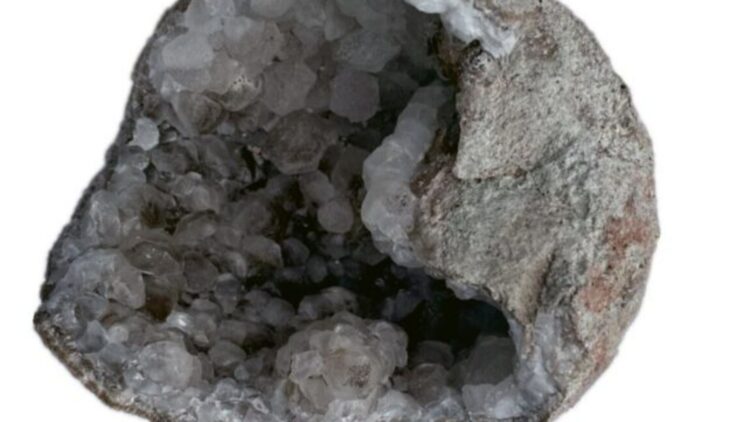
Imagine opening a dinosaur egg… and finding minerals inside. That is what happened in China with a fossil that dates back 70 million years. Inside it there were hundreds of calcite crystals, as if it had turned into a prehistoric geode, with no embryo, no bones, but many crystals inside.
And beyond how beautiful this discovery may be, it shows us a bit of how climate, water, and the processes at the end of the Cretaceous left their mark on this egg.
A new species?
This egg was found in Chisan, a formation within the Qianshan Basin in eastern China. In this area, remains this old had never been found before, and even less dinosaur remains. Researchers thought they would find organic remains or some sediments, but what was inside this egg was much more. An interior completely lined with crystals. Something like this had never been seen in paleontology, and now we know it.
The researchers analyzed the shell under a microscope and confirmed that, in addition to everything else, it was a new species, which they named Shixingoolithus qianshanensis.
How does an egg end up full of crystals?
That is the question scientists tried to answer. The first thing to make clear is that the embryo never developed, or decomposed very early, leaving the egg empty. Over thousands and thousands of years, water began to seep through the pores of the shell, which is why they tell you never to wash eggs before consuming them.
That water carried dissolved minerals, and little by little, with each drop, those minerals were deposited inside the egg. Since there were no atmospheric processes that damaged it, a true geode slowly formed inside, the one we can see today. Obviously, this did not happen overnight. Thousands of years passed until it reached the result we see now.
Something much more than beautiful
Yes, it is beautiful, but the important thing about this discovery is that these crystals contain a lot of information, such as being able to reconstruct data about what the temperature was like in that environment, what the water composition was, or what the climatic conditions were like 70 million years ago.
Similar structures have even been used to directly date dinosaur eggs, something that until recently seemed impossible. So this egg is not only rare and striking, it is also a scientific tool.
A fossil without a dinosaur…
But with a lot of history. It is not yet known which dinosaur species laid the egg. There is no associated skeleton and it has a new name, but it is clear that by its size and by the composition and structure of the shell, it is a dinosaur egg, and there is no debate about that.
Is it important?
Of course. For paleontologists and for natural history it is, far beyond being displayed behind a glass case in a museum. It is a natural record of what our planet was like and of how, sometimes, things are not preserved in the way we expect. Or did anyone expect to find a dinosaur egg full of crystals?
It is clear that we still do not know 100 percent what the Earth was like 70 million years ago, but what it has left us as a reminder is, without a doubt, wonderful.