
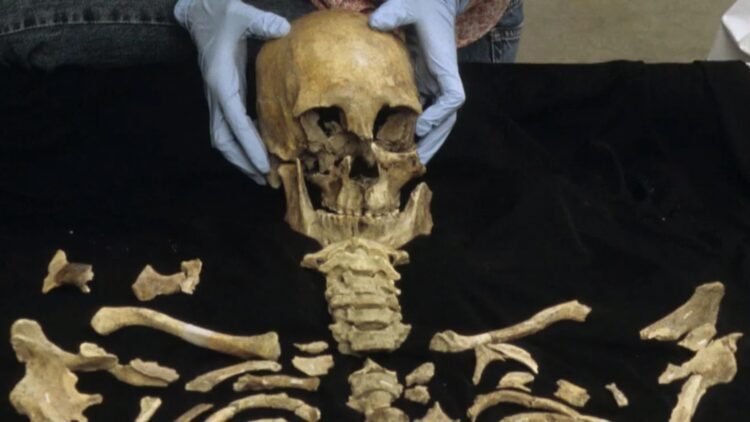
Today, we are going to tell you the mystery of the 9,000 years old skeleton that changed the history of America. Sometimes history appears when you don’t expect, which happens with many archaeological excavations, and this is what happened in this story.
In 1996, in the city of Kennewick (Washington) two men who went to a boat race found something that would change the view of the first inhabitants of America: a skeleton of almost 9,000 years old. To know more details about this finding, you should keep reading.
A surprising finding
Who were the two men who found the skeleton? Their names are: Will Thomas and David Deacy. One day they were so happy enjoying the fresh air when they suddenly saw something on the bank of the Columbia river. They were so curious, as most of us would, that they decided to get closer to find it was a human skull. They didn’t know what to do at that moment, I mean who would? But, the common thing to do, and what they did, was to call the police and give it to them.
This might seem like an isolated discovery, but nothing far from the truth. This ended up being one of the most important archaeological pieces in North America.
Later, scientists confirmed it was an almost complete skeleton of more than 8,400 years old, and they gave it the name of Kennewick Man or The Ancient One.
Who is the Kennewick Man?
The first thing we could learn about the skeleton was that it belonged to a tall and strong man in his forties. He was probably a hunter who lived near the coast. But, the most surprising thing was found on his bones: a spear stuck in his hip, which was a sign of having survived a serious wound during his life.
Wait! Because that’s not all. There’s another shocking aspect that caught scientists’ attention: the shape of the skull. Some scientists thought it didn’t look like the features of current native Americans, which started a huge debate on whether this man was a direct ancestor of indigenous places or someone totally different?
Conflict for the skeleton
This finding was really important for science, of course, but it was also a political and cultural issue. Several native tribes from the Northeast of the United States confirmed this skeleton belonged to their ancestors and claimed it back to give him a burial.
Where’s the conflict then? Well, researchers wanted to keep it to study it more and learn more about the first inhabitants of America. And here’s when the legal conflict started, which lasted for almost 20 years and involved the U.S. Army, anthropologists, lawyers, and the tribes themselves.
The DNA solved the mystery
Fortunately, in 2015 science had a final answer. Thanks to genetics, scientists could analyze the skeleton’s DNA and check it was directly related to the native American places of the region. So, what was the conclusion? The Kennewick Man was no stranger, but an ancestor.
Knowing this, the legal conflict ended and in 2017 more than 200 people took part in a tribal ceremony to bury once again the Kennewick Man.
The skeleton that changed history
Not only this skeleton solved an archaeological mystery, but also helped the tribes to confirm what they have been defending for so long: their North American roots are so deep and millenary.
What’s more, this discovery was very useful to learn about the importance of respecting human remains and the history of indigenous populations. Of course, science has to give answers, but it’s also necessary to listen to the communities that preserve the memory of their ancestors. We should build a future based on respect and knowledge.