
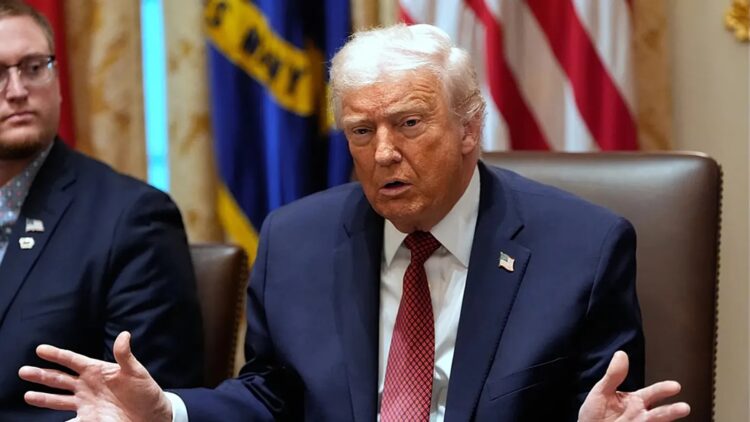
A major case being discussed in the United States Supreme Court: the Court is deciding whether President Donald Trump was allowed to fire a member of the Federal Trade Commission (FTC) before her term ended. The decision could give Trump even more power and, at the same time, weaken a legal rule that has existed for almost 90 years. So, let’s learn more about this situation.
Why the Supreme Court is involved
The Supreme Court is listening to arguments in a case where the Justice Department wants the Court to say that Trump did have the right to fire Rebecca Slaughter, who was a Democratic member of the FTC. She was dismissed in March, even when her term should have really ended in 2029. A lower court had said Trump went beyond his authority, so now the case has reached the highest court.
Currently, the Court has a 6-3 conservative majority, and it has already supported Trump in several cases since he returned to the presidency. During the arguments, many conservative justices seemed ready to agree with Trump’s position.
Conservative justices and Trump
The conservative justices seemed to agree with the idea that Congress gave too much protection to leaders of independent agencies like the FTC. The Trump administration argues that these protections limit the president’s power, which the Constitution gives to the executive branch.
This case also involves a popular decision in 1935 called Humphrey’s Executor v. United States. This decision established that a president can’t fire leaders of independent agencies just because he or she doesn’t agree with their decisions, this can only be done as a consequence of serious reasons like neglect or wrongdoing. The Trump administration asked the Court to overturn that decision completely. Although the Court has reduced its importance over time, it has never fully removed it.
Chief Justice John Roberts, a conservative, suggested that the 1935 ruling is out of date, arguing the FTC back then was much weaker compared to now. He described the old decision as a “dried husk,” meaning it may no longer be useful in today’s world.
Liberal justices have some concerns
The liberal justices strongly disagreed with the idea of giving more removal power to the president. Justice Elena Kagan said a ruling in Trump’s favor would give the president “massive, unchecked, uncontrolled power.” She explained that independent agencies have huge responsibilities in American life, such as supervising finance, transportation safety, and labor relations. So, if the president could fire leaders of these agencies at will, the balance of power could be destroyed.
Then, justice Ketanji Brown Jackson said the same thing: Congress created these agencies so that experts — scientists, doctors, economists, and others — could do their jobs without political interference. She warned that a president could fire all these experts and replace them with loyalists who lack knowledge, which she said would harm the country.
Last, but not least, justice Sonia Sotomayor pointed out that independent agencies have existed for a long time in U.S. history. She argued that even the leaders in England at the time of America’s founding did not have unlimited firing power. She said the Trump administration was asking the Court to “destroy the structure of government.”
Trump’s administration
Solicitor General Sauer argued that the 1935 decision allows Congress to create overly independent agencies, almost like a “fourth branch” of government, and said the president should have full control over them.
Some conservative justices questioned whether limiting the president’s ability to fire agency heads only to certain areas weakens his authority, and whether Congress could continue creating more independent agencies. Justice Kavanaugh asked if a ruling in Trump’s favor could affect the Federal Reserve’s independence, but Sauer said that institution is unique.
Also, the Court will hear another case where Trump is attempting to remove a Federal Reserve member, an unprecedented move, and some justices are concerned that a ruling in his favor could impact even special courts.
So…
With Trump pushing for more control and the Court weighing nearly 90 years of precedent, the decision could either expand presidential authority dramatically or protect the independence that keeps parts of the government nonpartisan. The stakes for the balance of power in the U.S. have never been higher.