
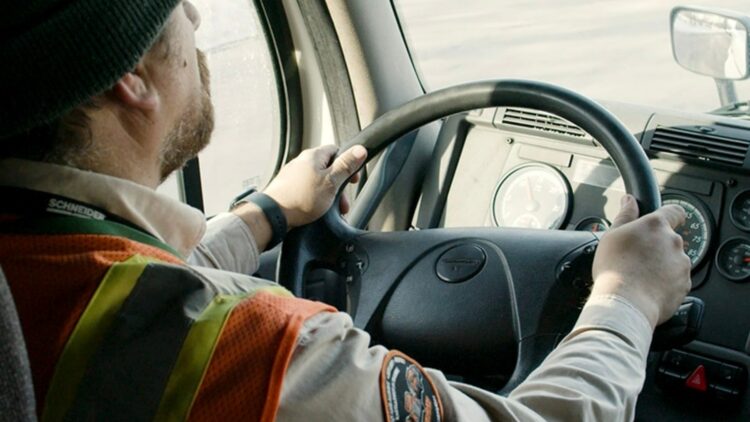
5500 is the number of truck drivers who have lost their commercial license in our country… the reason? They don’t know how to speak English (they have not passed a basic test that is now mandatory). And yes, they need it to drive heavy loads across our country.
It has obviously been our beloved president Donald Trump who reactivated this measure: every transport driver must be able to read traffic signs and interact with the police (in English, of course!). But… what about the southern border? Thousands of Mexicans cross that border every day, transporting goods back and forth… what is going to happen to them?
A law that returns with strength
The requirement to speak English is not new; it already existed years ago, but it was more a formality than a strict rule. Until six months ago, when the White House ordered to strengthen the language controls through the Department of Transportation (DOT).
According to Israel Delgado Vallejo, vice president of the Northwestern Chamber of Freight Carriers of Mexico, 5,500 licenses have already been suspended or canceled for not meeting the required level of English.
“We are seeing a tougher, stricter application.”
Most of the suspensions are concentrated in Texas, California, Arizona, and New Mexico. The DOT warned that states that do not apply this policy could lose federal funding. So, like it or not, it will have to be followed.
Eight out of ten truck drivers do not speak English
Delgado Vallejo says that 80% of truck drivers who work in the border area between Mexico and the United States do not speak English.
Many of them have been doing fixed routes for years, crossing through the same points and following GPS systems or bilingual signs. They are experts at their job, no one doubts that, but now they could be left out of the commercial licensing system, which would put at risk not only their employment but also the daily trade between both countries.
A blow with economic and human impact
More than 80,000 truck drivers move cargo every day between Mexico and the United States: vehicles, food, industrial materials… everything that keeps the North American supply chain running.
If thousands of them lose their license, delivery times will increase and costs will rise.
And then there is the human impact.
Truckers’ unions insist that it is not about refusing to learn English, but about not having the means or the time to do it.
“You can’t ask someone to change their life in three months without offering help,” said a union representative in El Paso. “This doesn’t improve safety, it just leaves more families without income.”
Some apply it, others resist
In California the Department of Transportation has already said it will not revoke licenses only for language issues, arguing that its priority is road safety, not language fluency.
But Texas and Arizona are applying the rule. Highway patrols are already carrying out random checks, and the exams have multiplied in recent months.
At this point, conflict seems inevitable… State governments, unions, and the DOT itself are preparing for a long dispute, while the threat of losing federal funds looms overhead.
Safety or discrimination?
The government defends the measure under a public safety argument, saying that drivers must be able to read signs, understand police orders, or explain an emergency without a translator. But for critics, there’s something behind it.
They see this policy as a hidden form of discrimination, especially toward Hispanic or migrant workers with years of experience.
“This is not a safety issue, it’s an excuse,” say the unions.
And it is curious that this happens just when tensions over migration are at their highest, isn’t it?
For now, the unions are asking for common sense. They are not against the exams, but they demand time, support, and respect. Language courses, reasonable deadlines, and a bit of humanity in the application of the rules, please.