
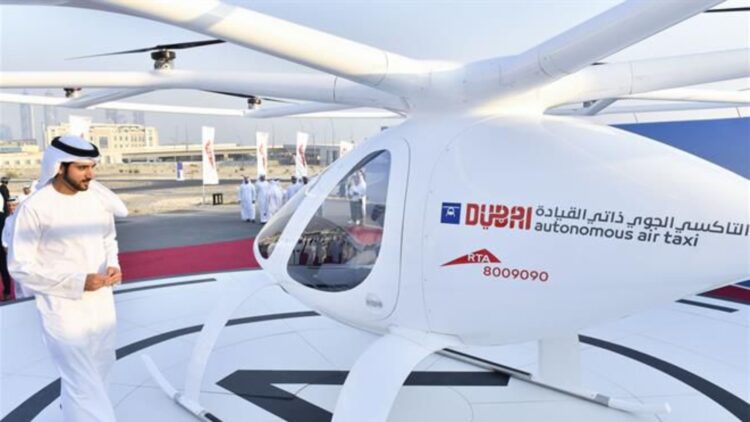
Flying taxis? Yeah! This is true and Dubai is going to start using them to take passengers very soon to avoid traffic jams that normally collapse the roads. According to Euronews, the city is preparing the launching of these electric aircrafts that vertically take off and land (known as eVTOL), and it’s expected to become one of the first cities in the world to offer this type of futuristic form of transport. So, let’s learn more about what Dubai is doing, shall we?
Flying taxis
These are electric vehicles capable of vertically taking off, hovering, and landing; similar to a helicopter, but these futuristic taxis are quieter, lighter, and more environmentally friendly because they work with electricity instead of fuel.
The aim is to take passengers fast from one point to another, reducing time travelling and avoiding Earth traffic. These vehicles are great for big cities where traffic jams are an everyday issue. What’s more, since they work with electric batteries, flying taxis in Dubai don’t pollute the air and generate way less noise than helicopters. This is why many experts consider it a solution for the transport of the future, combining speed, sustainability, and comfort.
Dubai
Dubai, one of the most advanced cities in the United Arab Emirates (UAE), is famous for its luxury lifestyle, modern architecture, and technological innovation. From its record-breaking skyscrapers to its driverless metro, the city has always aimed to stay ahead of the curve. Now, Dubai wants to take that innovation to the skies. The city’s Civil Aviation Authority has been working on plans to create “air roads,” safe routes in the sky that flying taxis can use to transport people from one location to another.
This means Dubai is planning a kind of air traffic system where flying taxis can move safely and efficiently, just like cars on the road.
The Xpeng Land Aircraft Carrier
One of the most advanced models that has already been tested in Dubai is the Land Aircraft Carrier, made by the Chinese company Xpeng AeroHT. This two-seat flying taxi can fly with or without a pilot, which proves its high level of technology and safety. On October 12, the company experienced a successful demonstration when flying in Dubai’s sky.
Michael Du, Chief Financial Officer and Vice President of Xpeng AeroHT, explained that the company has already built 200 of these vehicles and conducted more than 5,000 test flights. These tests were carried out in extreme conditions — high heat, cold weather, high altitude, and humidity — to make sure the vehicle is safe and reliable.
During the demonstration, it was also presented a six-wheeled all-terrain vehicle designed to carry the flying taxi. According to Du, this will ease its usage and increase the number of people using this new means of transport.
Challenges
Even though the advances are many, the flying taxis in Dubai still need to solve some challenges before they become a daily reality. Among the main challenges we find:
- Battery autonomy: The aircraft need longer flight times without frequent recharging.
- Air traffic control: Dubai will need a new system to manage multiple flying vehicles safely.
- Infrastructure: The city must build special landing and takeoff areas, known as “vertiports,” as well as charging stations for the eVTOLs.
However, Xpeng announced that the Land Aircraft Carrier model will be commercially available in Dubai in 2027 and there are already 600 orders confirmed!
So, if everything goes as planned, by the end of this decade, Dubai’s skies could be full of flying taxis, taking passengers quickly across the city and turning the dream of air travel for everyone into a daily reality. Isn’t it crazy how fast we are getting to experience what we once watched in science-fiction movies?