
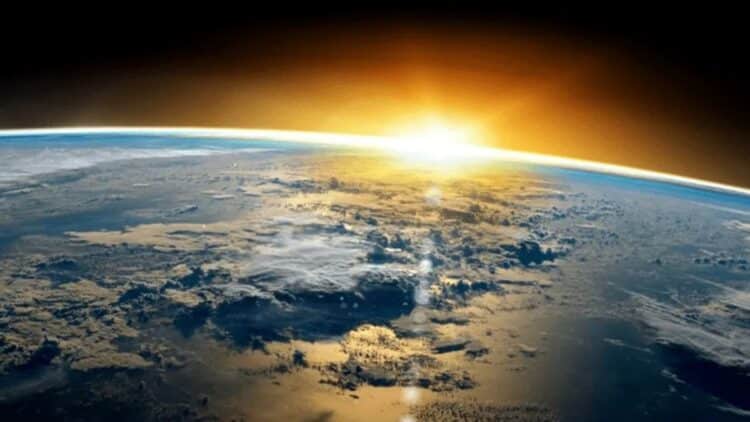
Maybe you wouldn’t imagine it either, but our atmosphere won’t last forever as we know it. Wait, we’re not saying that tomorrow the oxygen will run out and we’ll all die, but according to Nature Geoscience, our atmosphere is just a stage and at some point it will cease to exist.
According to researchers Kazumi Ozaki and Christopher T. Reinhard, in about a billion years, oxygen levels could drop so low that life as we know it would be impossible, meaning our planet would become almost unbreathable (fortunately or unfortunately, we won’t be here to see it).
Oxygen has an expiration date
Scientists estimate that Earth’s atmosphere will maintain “breathable” levels for only the next billion years or so, enough time for you to finish the laundry.
After that, everything will change, and not because of pollution or humans (although that’s another topic), but because of the Sun. Its brightness will increase, global temperatures will rise, and the planet’s carbon cycles will be altered. Plants won’t be able to survive those conditions and will no longer be able to perform photosynthesis. Without photosynthesis, there’s no oxygen, and without oxygen, there are no humans (unless millions of years from now we somehow adapt to depend on another element, who knows).
So, most likely, our planet will go back to the beginning, to an atmosphere dominated by methane and carbon dioxide.
Why oxygen will disappear
There are three main reasons believed to be behind this. The first is that the Sun will become hotter, radiate more energy, and directly affect the planet’s chemical balance.
As CO2 becomes scarce, plants won’t be able to produce oxygen and will eventually disappear, followed by humans. As a result, Earth will begin to experience different kinds of activity, such as increased volcanic activity.
An unrecognizable Earth
Life might not end completely at that point, but it will change. There will be no animals, no plants, and no humans. Our planet will be left to microbes, anaerobic organisms, or other life forms capable of surviving without oxygen, and the landscapes will change too (the oceans will disappear, the sky will lose its blue color, and our planet will begin to look orange), something closer to Titan (Saturn’s moon).
An apocalyptic prediction?
Wait, this is just a simulation based on the data we currently have. Models could change, new discoveries could be made, or thousands of factors we don’t yet know could come into play. Still, scientists agree on two things: first, our generation won’t experience it, and second, oxygen is not eternal.
So, we’ll have to start imagining a future without oxygen. Who knows, by then we may have conquered other planets where life is possible, or developed another way to survive. For now, what we can do is enjoy and take care of this wonderful world that won’t exist twice! And enjoy the fresh air, because someday others might not be as lucky as we are!
If you found this article interesting, you can read the original information at the following link. Enjoy!
FAQ: How long will the Earth keep breathing?
- What did scientists discover about Earth’s oxygen?: That our atmosphere won’t last forever; it will last about one billion more years.
- Why will oxygen decrease?: Because the Sun will become brighter (hotter), causing chemical changes that will end plant photosynthesis (no more oxygen or CO2).
- What will happen when oxygen starts to disappear?: Our planet will have more methane, the sky will stop being blue, and organisms (animals and plants) will vanish. Only microbes will survive.
- Does this mean the end of life on Earth?: Human life, yes.
- When would this change happen?: In millions of years.