
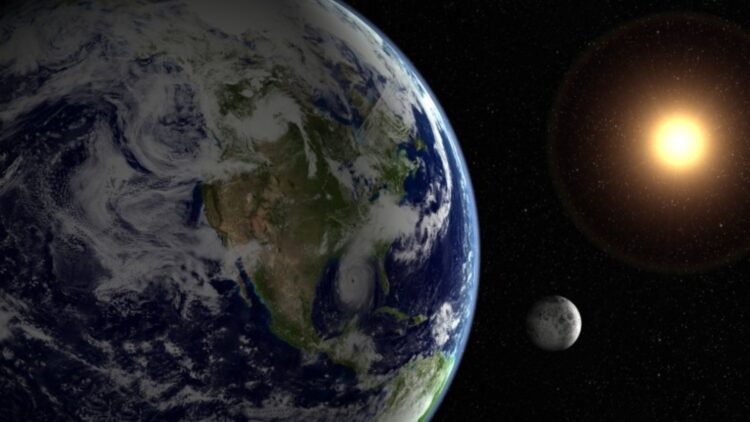
Don’t you feel 24-hour days aren’t enough? Well, Earth is accelerating its turn, so some days of 2025 will be even shorter! Graham Jones, an astrophysic, along with the International Earth Rotation and Reference Systems Service (IERS) and the U.S. Naval Observatory (USNO), warns about the Earth rotation being shortened by millimeters which has been confirmed by atomic clocks. According to timeanddate.com, the day length could reach historic lows, influenced by factors internal to the planet… and also by the Moon – a common topic of NASA’s missions. So, let’s find out what’s happening to our planet Earth!
Shorter days in 2025
For some years now, scientists have noticed something striking: the Earth’s rotation is speeding up slightly. This means that, instead of taking exactly 24 hours to rotate on its axis, the planet sometimes does it in a few milliseconds less. Although this difference is so small that can’t be even noticed by people, it is measurable with very precise scientific tools, such as atomic clocks.
This acceleration doesn’t happen all the time. However, since 2020, scientists have recorded several days that were shorter than usual. The exact length of a day is calculated on the basis of the so-called LOD (Length of Day), which indicates the difference from the standard 24 hours, i.e. 86,400 seconds. When the LOD is negative, it means that the day was shorter than normal.
According to the International Earth Rotation and Reference Systems Service (IERS) and the United States Naval Observatory (USNO), measurements show that this trend could intensify in 2025.
Exact days that will be shorter
Astrophysicist Graham Jones, a specialist in analyzing changes in the Earth’s rotation, has talked about three dates in 2025 that the Earth could complete its rotation in a shorter time than any other day recorded so far with modern technology – July 5, 2024, when the day lasted 1.66 milliseconds less than the standard 24 hours. So, let’s see what days are those:
- July 9: expected day length with LOD of -1.30 milliseconds.
- July 22: LOD of -1.38 milliseconds
- August 5: LOD of -1.51 milliseconds
The reason behind this issue
We don’t know for sure what’s the exact reason for this issue, but there are some theories that could explain the Earth’s rotational acceleration. Some of the factors that could affect this situation are:
- Changes in the Earth’s core, which could affect the planet’s moment of inertia.
- Ocean currents that redistribute water masses.
- Atmospheric alterations, such as variations in global winds.
- The distance of the Moon from the Earth’s equator, which can have an effect on the rotational equilibrium of the planet.
Is this a problem for our daily lives?
For most people, these milliseconds of difference do not affect their daily routine. However, everything that depends on technology will be affected because many modern systems rely on precise synchronization based on atomic time, such as:
- Artificial satellites
- GPS systems
- Global telecommunications networks
- Air and maritime navigation systems
Faster rotation may make it necessary to adjust atomic clocks or introduce a “negative leap second,” something that has never been done before, to keep civil time and astronomical time aligned.
What’s coming up next
This is a topic of interest for scientists, that’s why they will keep investigating the Earth’s rotation. It’s true there’s no reason to worry about this change, but scientists will continue to observe this phenomenon, which is very useful for the way we measure time and for the way our technology works.
Scientific research never stops surprising us, no matter what topic they focus on, they always come up with something new that will be relevant for the future of our planet. This new research shows the shortening of day length, which means less time to do things! Would you rather our days to be shorter or longer?