
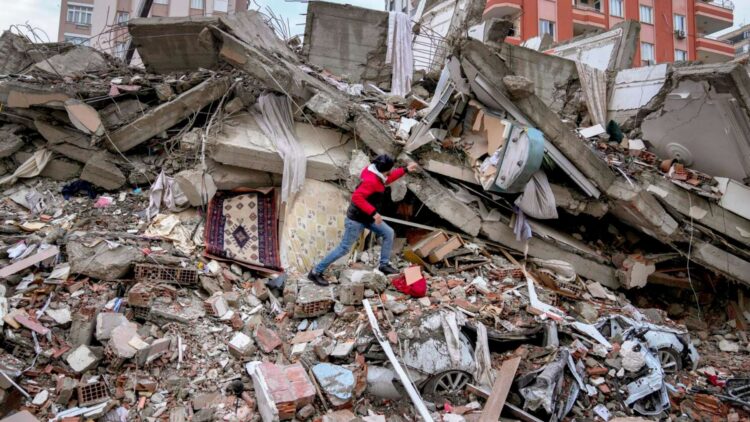
Earthquakes are cruel, they do not warn that they are coming. The ground begins to shake beneath your feet and in a matter of seconds it can destroy cities. They cannot be predicted, but now there is a new method that allows much faster earthquake simulations and thus makes it possible to calculate potential risks.
Why earthquakes cannot be predicted
Because they simply happen. Pressure builds up for a long time between tectonic plates and then that energy is suddenly released, depending on a thousand factors, and there is no signal that warns seismographs. Sometimes there are small tremors, but not always. To “predict” them, thousands of data points are used to refine where one might occur and how strong it could be.
Everything happens underground
If you attended elementary school science classes, you may remember that an earthquake is not experienced the same way everywhere. Some soils amplify vibrations (sand, fill, soft clays), while others dampen them. That is why two neighborhoods just a few kilometers apart can suffer completely different damage. Knowing what the ground is like can help anticipate and plan for the impact.
Simulating earthquakes
Using computers, scientists generate “virtual” earthquakes. They create digital seismic waves, send them through a subsurface model, and compare the result with what real seismographs record.
Then they adjust the model to something realistic, repeat the process, and adjust again until the “digital earthquake” ends up resembling the real one.
Very slow and very expensive
The drawback is that these simulations are very slow. A single one can take hours even on supercomputers, and since thousands of simulations are needed to reach a reliable conclusion, it requires time, money, resources, and a lot of patience. This greatly limits their continuous use.
But there is a trick
A new method performs the calculations in a more reduced or smarter way, without doing all the brute-force work. According to researchers, the system to be solved is reduced by up to a thousand times. What was previously impractical becomes quite viable. The earthquake does not change, but the calculations performed on it do.
What changes with this?
We still will not be able to predict earthquakes, but it will help evaluate potential risks more accurately. With more realistic subsurface models, it is possible to identify the most vulnerable areas in order to reinforce buildings or plan other types of infrastructure improvements.
Preparation instead of guesswork
There is no perfect prediction, and we must stop chasing the idea that one exists. It cannot be controlled for now, and that is something we must accept. Earthquakes cannot be predicted, but we can improve how we respond to them. This is preparation based on science.
And tsunamis?
If what happens under the sea can be simulated more quickly, it is also possible to improve responses when a tsunami occurs. Time is critical in these cases, and sometimes having just one hour of warning is enough to evacuate a large part of the population.
Earthquakes will not disappear, but now we can work a little better on how we protect and build our towns. Earthquakes will continue to happen, obviously, that depends on tectonic plates and not on us, but now we may have a bit more room to understand how and why the ground beneath our feet moves.