
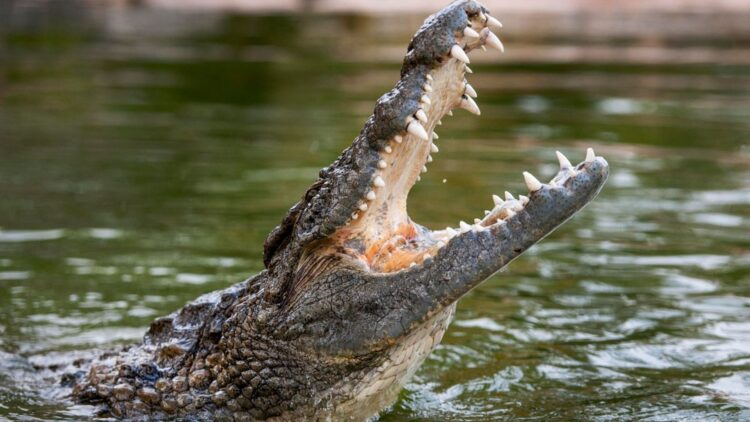
In the middle of the Egyptian desert, a fossil of a previously unknown species has been discovered. It has been named Wadisuchus kassabi (because it was found in the Wadi Desert), and it is a marine predator that swam along the African coasts about 80 million years ago.
According to researchers, this animal would be the oldest known ancestor of prehistoric marine crocodiles, and they estimate its origin to be about seven million years earlier than previously thought! Something never before imagined, Africa was the cradle of crocodiles.
A hunter from the Cretaceous
The Wadisuchus kassabi measured between 3.5 and 4 meters long, with an elongated snout and teeth as fine and sharp as needles, perfect for catching fish and turtles. And yes, it was different from modern crocodiles because it was completely aquatic. It could swim long distances, move with agility, and hunt in coastal waters.
The fossils (four of different ages) were found in the Kharga and Baris oases and show key stages between terrestrial crocodiles (the ones we know) and marine ones, as if it were the missing link of the family.
A bite?
This crocodile was terrifying. Its snout was shorter and more compact than that of other primitive species, it had only four front teeth (one less than usual), and nostrils at the top of its face, like modern marine animals that can breathe without coming out of the water.
In addition, its jaw shows a deep groove, suggesting a very powerful bite, capable of crushing shells and carapaces. Terrifying…
And the most curious thing is that the Quesir Formation (the site where it was found), which is now a desert, was millions of years ago a tropical plain.
Africa, the true origin
The Wadisuchus kassabi is the direct ancestor of the dyrosaurids, a family of marine crocodiles that even survived the extinction of the dinosaurs and later spread across America, Europe, and the rest of Africa.
“Marine crocodiles did not originate in Asia or America. Their story began here, in Africa”.
A name with history
“Wadi” means valley in Arabic, referring to the place where it was found. “Suchus” comes from Sobek, the Egyptian crocodile god, symbol of strength and fertility.
And “kassabi” honors paleontologist Ahmed Kassab, a pioneer in the study of fossils in Egypt.
The discovery was led by the Mansoura University Vertebrate Paleontology Center (MUVP), an institution that is positioning Egypt as one of the major references in modern paleontology.
Its researchers are using digital scanning technology and 3D reconstructions to bring back from oblivion the creatures that once ruled the ancient Egyptian sea.
The problem is that urban and agricultural expansion is putting many of these sites at risk before they can be studied.
That is why experts are calling for them to be protected as paleontological heritage, before progress erases these pages of Earth’s history.
“Each lost fossil is a story we will never be able to tell again” laments Salem.
To sump up!
The Wadisuchus kassabi is a key piece that rewrites the history of crocodiles and reaffirms the role of Africa (and Egypt in particular) as one of the richest cradles of evolution.
Beneath the sands where silence now reigns, 80 million years ago, giants swam and the sea roared.
And thanks to discoveries like this, the desert speaks again, reminding us that every grain of sand may hide an entire chapter of life on Earth.