
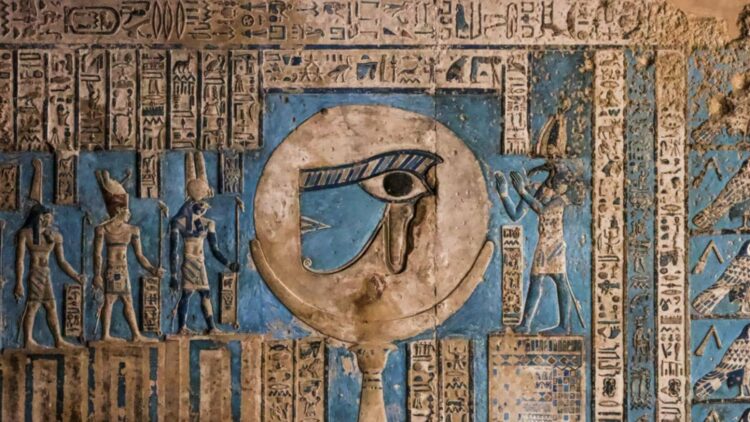
There are many kinds of blue. Sky blue, princess blue. Royal blue, cyan blue, baby blue, navy… But what if we told you about Egyptian blue? Does it sound familiar to you? That deep cobalt tone found on the walls of ancient Egypt, on monuments, sculptures, murals, ceramics, and even coffins. A pigment so unique it has been impossible to recreate throughout all these years of history.
Egyptian blue
The oldest sample dates back to 3250 BC, and it was later used by the Romans who conquered Ancient Egypt in the 1st century BC. But the original recipe was lost to time and that special, unmistakable shade of blue could never be produced again… until now.
From pharaonic dynasties to modern laboratories
At first glance, recovering a pigment may not seem that complicated and could be a task for any art historian. But Egyptian blue is not just any blue. This pigment has a crystalline structure (cuprorivaite) capable of absorbing red light and emitting infrared radiation, a luminescence phenomenon that fascinates modern science. Just one more reason to believe the Egyptians were actually aliens.
Researchers from Washington State University, the Carnegie Museum of Natural History, and the Smithsonian Museum Conservation Institute recreated up to twelve versions of the lost formula using silica, sodium carbonate, lime, and copper, heated to over 1,000°C for eleven hours.
John McCloy, lead author of the discovery and director of the School of Mechanical Engineering at Washington State, explained that even small differences in the process produced very different tones. Both the cooking time and the proportions of the ingredients completely changed the final color.
And they were doing it without scales or ovens!
The rebirth of a material
All twelve tests had something in common: the cuprorivaite “activates” with red light, glows, and emits infrared light. Wow! What’s that good for? It’s actually a simple way to identify Egyptian blue, even if it’s hidden under other layers of paint.
This makes it much easier for archaeologists and historians to know whether a painting was touched up with a different blue, even if it’s barely noticeable to the naked eye.
It seems unbelievable that a 5,000-year-old invention is now making a comeback as cutting-edge technology.
Even Raphael, in The Triumph of Galatea (which the Renaissance painter created for the Villa Farnesina around 1512), recreated and used Egyptian blue. The ancient Romans used Egyptian blue mixed with white pigment to make the eyes look more translucent and natural.
Beyond aesthetics
This pigment emits light that’s invisible to the naked eye, so some experts have proposed using it in new applications, for example, for fingerprint detection or anti-counterfeit ink. It’s art and science!
From the sarcophagi of Saqqara to the murals of Pompeii, Egyptian blue acted as a bridge between civilizations… Then it disappeared. But the results of this research have shown us there’s a second chapter for this color, and it’s once again something incredible, both for science and art.
A process this sophisticated, in a cultural context with no access to today’s technology, is that more fuel for conspiracy theories about the Egyptian empire? Maybe.
This shade of blue has been a symbol of Egypt and its religious practices for centuries, and part of everyday life for those who lived during that time. Now it seems we’ve travelled back in time to recover that precious lost recipe, used by the oldest pharaohs, the same blue Cleopatra loved! And now we get to experience it too. Wow, science is incredible, don’t you think?