
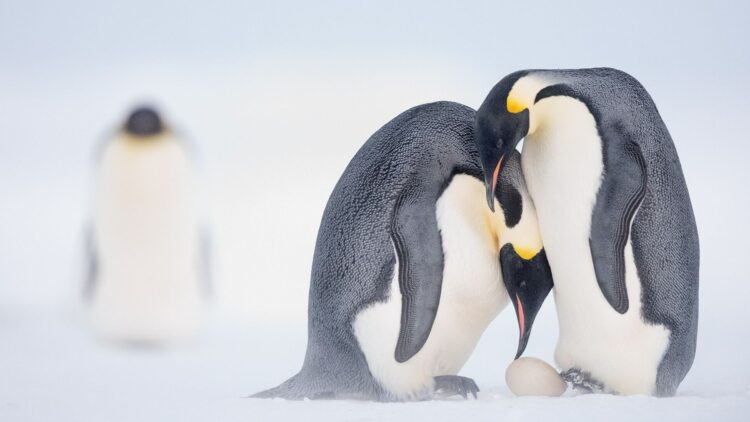
The emperor penguin (Aptenodytes forsteri), the king of Antarctica, with its short little steps and its snow-white chest. Behind one of our favourite animals lies a sad story: their homes are disappearing, and with them, their chances of survival. These penguins are facing their greatest known threat because Antarctica is experiencing a 22% drop in its snow levels.
Scientists from the British Antarctic Survey have just issued a loud alarm: this adorable animal is disappearing faster than we imagined, and if we don’t act now, it could become nothing more than a memory in books… Up next, we’ll tell you why their population is shrinking, what climate change has to do with it, and what we can do (yes, even from home) so the emperor of ice can keep ruling.
What’s happening to emperor penguins?
The BAS (British Antarctic Survey) study analysed 2.8 million km² and identified that almost a third of the global emperor penguin population lives in this area. The most unsettling finding is the average annual loss of 1.6%, a pace that, if repeated across the continent, would bring total extinction closer to the year 2100… Not even the most pessimistic studies gave these penguins so little time. The figures are staggering…
Sea ice is melting
Seasonal sea ice is both cradle and castle for these emperors: it’s where they court, incubate, and protect their chicks. They need a solid platform for at least eight months a year. However, temperature spikes are causing the ice to break apart too early, leaving chicks stranded and exposed to freezing waters before they’ve shed their protective down. And when that happens…
Storms and predators, allies of decline
More intense storms, and shifting patterns of snow and out-of-season rain are also part of the problem. On top of that, predators like the leopard seal are moving into areas once protected by the cold, making survival extremely difficult for these animals.
With temperature changes and less ice, their food sources (like fish and krill) are also changing habitats to escape those waters, leaving these animals without food.
Counting penguins from space
It sounds like an extremely difficult task, but it’s currently the only effective way to know how many penguins there are, since reaching the colonies means crossing one of the most hostile deserts on the planet.
Science has turned its eyes to the sky, and through high-resolution satellites, researchers can detect the dark spots of thousands of birds on the ice and measure populations with a reduced margin of error, without disturbing the ecosystem.
And yes, these studies have revealed a discouraging truth: there are fewer and fewer penguins.
What’s changed?
Projections from a decade ago assumed a scenario of moderate emissions and limited warming, but the reality is that the planet is melting and accelerating the thaw. We’re already living in the worst-case scenario.
If emissions aren’t stabilized in the next decade, colonies could see their numbers cut in half before 2050, irreversibly compromising the species’ genetic diversity…
A thermometer for the planet
Of course, this doesn’t only affect the emperor penguin, it affects all of us. Their decline is a direct indicator of global climate health. The Southern Ocean regulates currents that influence the climate on all five continents. The rapid loss of ice disrupts this chilling machinery and could intensify extreme events like hurricanes or droughts.
Is there hope? Urgent measures and possible solutions
The window for action is still open. Keeping warming below 1.5 °C, the goal of the Paris Agreement, is the minimum threshold to give the Antarctic ecosystem a breather. This means:
- A drastic reduction in fossil fuels is essential to contain the temperature rise that’s destroying sea ice.
- Limiting industrial fishing around colonies ensures food and reduces pressure on the food chain.
- Strengthening programs like the BAS and sharing real-time data improves our ability to respond to sudden changes.
But will it be enough? And above all… will we make it in time? The planet is heating up and we’re already running in reverse. If we don’t realize that we only have one planet (and one life), we could be burying life itself under these scorching temperatures…