
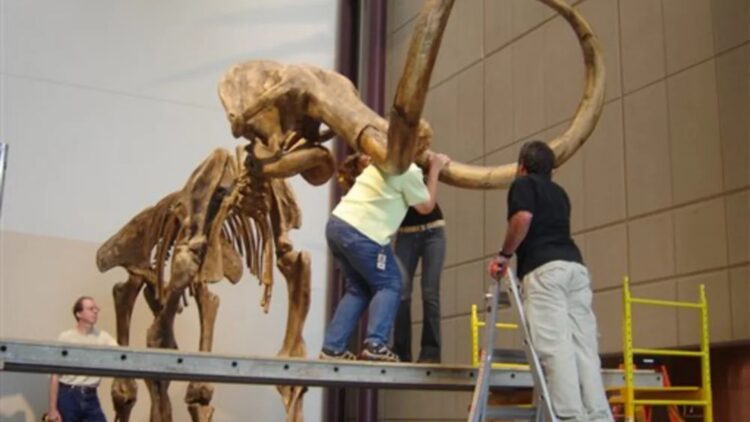
A museum spent 70 years storing a treasure, believing it was the remains of one of the last woolly mammoths on the planet. They were well catalogued and well preserved, found in Alaska in 1951, and they also fit perfectly with the story of prehistoric megafauna. But wait, were we sure those remains belonged to a woolly mammoth? Science was not so sure 70 years after their discovery!
No one questioned it
The bones were discovered by archaeologist Otto Geist during an expedition near Fairbanks, in a region called Beringia, known for being an area full of prehistoric history. The size fit, the location too and, honestly, who would suspect anything else?
So the remains ended up at the University of Alaska Museum of the North, where they spent decades and decades in storage, they were just another mammoth.
And what happened?
Years later, the museum decided to submit the bones to radiocarbon dating, something like just another procedure, but the result showed something different, something did not add up. The remains were between 2,000 and 3,000 years old. How could that be?
Too young to be woolly mammoths, which went extinct 13,000 years ago (except for some isolated groups that survived until about 4,000 years ago). If those bones were really from a mammoth, we would be looking at the youngest ever found. But… how would we know that?
With chemistry!
Scientists needed to clear up the doubts, so they decided to analyze the chemical composition of the bones, and there they found very high levels of nitrogen-15 and carbon-13. In human terms, this means it was an animal with a marine diet.
But wait, because those isotopes did not fit with a large terrestrial herbivore like a mammoth, but they did fit with other animals that live and feed in the ocean. What was it, what was it?!
Its DNA
Even though the genetic material was quite deteriorated, something normal after so many centuries, they managed to extract mitochondrial DNA to compare and find out what animal we were really dealing with.
Well no, it was not a mammoth. And it had been catalogued as one for 70 years! It was a whale, a North Pacific right whale or a minke whale.
But… what is a whale doing there?
Solving one mystery opened another even more puzzling one, how does a whale end up in the interior of Alaska more than 400 kilometers from the sea? Perhaps humans transported the bones from the coast, something that was done in other places, although there is not much evidence.
Another possibility is that the whale arrived through ancient seas or rivers that reached that area and have since disappeared.
Learning from the mistake
As you can see, science is not infallible, what we consider certain today can be studied again tomorrow and lead to different conclusions, so many times it is worth looking again at what we already have to keep learning about what the ancient world was like!
The study, published in the Journal of Quaternary Science, definitively rules out that it was the last mammoth in the world, but there are still many things to investigate and that makes it much more exciting.