
You know that saying, “they struck gold”? Well, what was supposed to be an expedition to search for the ship Endurance (Shackleton’s lost vessel) ended up becoming a new chapter in marine biology.
It all happened while a group of British scientists was exploring the Weddell Sea when they suddenly found thousands of perfectly organized fish nests beneath an area that until recently had been sealed by ice.
By chance
The team, made up of researchers from the University of Exeter, the Nekton Foundation, the National Oceanography Centre in Southampton, and Ocean Census, had set out to map the remains of the Endurance, the ship that sank in 1915 during Shackleton’s Antarctic expedition.
But fate had other plans for them, and when they diverted their route toward an area that had just been freed from ice after the detachment of the A68 iceberg, the underwater sensors began detecting strange structures on the seabed.
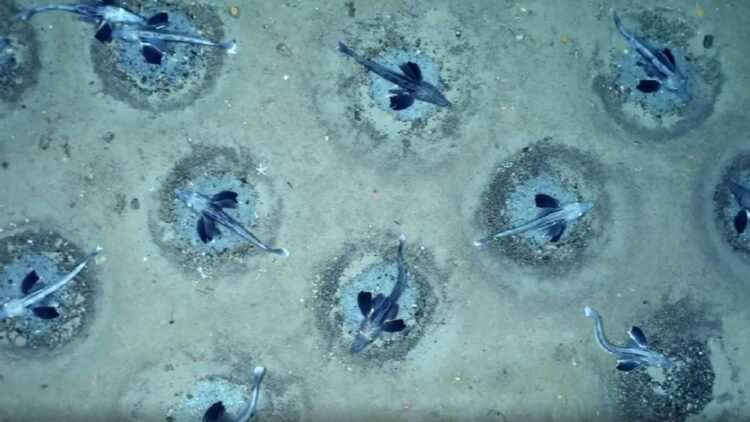
When they brought the cameras closer, the surprise was enormous: a city of nests stretching for several kilometers.
“We documented more than a thousand nests, each one with eggs guarded by adults. Everything was organized, as if someone had cleaned and designed the seabed”
Thousands of nests and an astonishing organization
The stars of this discovery are Antarctic fish of the genus Neopagetopsis, a species that until now was believed to be rather solitary.
Each nest (about 75 centimeters in diameter) contained a clutch of eggs guarded by an adult fish, which cleaned the area and kept possible predators away.
These nests were arranged in lines, circles, and perfectly symmetrical groups, like underwater neighborhoods (our version of housing developments) but such a large and organized fish colony had never been seen before.
The explored area covers several square kilometers, making it the largest fish breeding colony ever recorded on the planet.
The role of the ice
For centuries, this ecosystem was hidden beneath a thick layer of ice.
Only when the A68 iceberg broke away from the continent, something satellites detected in 2017, did a window open to explore what lay beneath.
Scientists believe that discoveries like this one can offer clues about how climate change is revealing new ecosystems, places that were previously impossible to study and that could harbor completely unknown forms of life.
“This discovery reminds us that the ocean still holds enormous secrets. We’ve only explored a tiny part of it”
Why do fish make nests?
Not all fish do this, only a few species(such as cichlids, gobies, or sticklebacks) do so to protect their eggs and increase the chances of their young surviving.
In this case, the Weddell Sea fish not only care for their eggs but do so cooperatively, sharing the space and maintaining an almost communal organization. A kind of “fish neighborhood” where each one has its own plot, task, and watch.
The team plans to return in 2026 with 3D technology to continue studying how this colony evolves over time and whether there are others like it hidden beneath the ice.
A hidden ecosystem
Beyond the wonder, this discovery has enormous implications.
The melting of ice is revealing areas of the ocean that have remained untouched for centuries, and what is found there could transform our understanding of the planet.
Researchers are already proposing that the Weddell Sea be declared a protected marine sanctuary to prevent fishing or human activity from disturbing this unique ecosystem.
What began as a mission to find a lost ship ended up revealing a hidden world beneath the ice, a megacolony of fish that organize themselves much better than we do! Nature still has so much to teach us, what a wonder.