
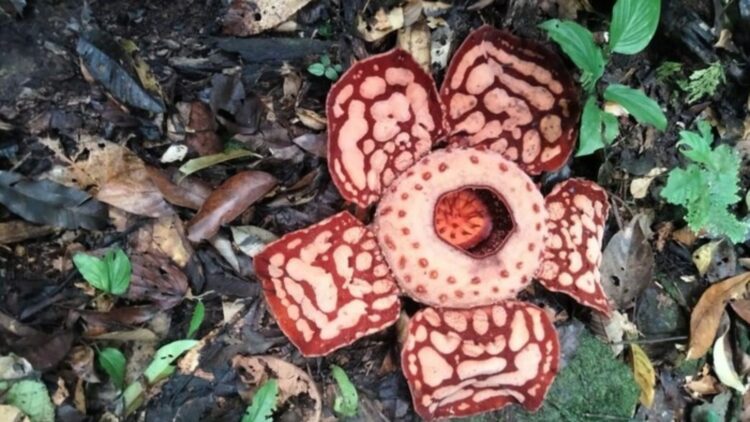
It is called Rafflesia Hasseltii and it is a flower that has just appeared after 13 years. And no, although it looks like it came straight out of the Upside Down from Stranger Things, we promise you that this peculiar flower exists and is not part of the Netflix cast.
It is huge, they spent 13 years searching and it was found by an exploration in the jungle of Sumatra (Indonesia). It is one of the strangest flowers seen so far, it is enormous (it can exceed up to 1 meter in diameter), it has no leaves or stem and it emits a smell like decomposed meat (yes, and it is a flower), and it blooms only between three and five days before disappearing.
Taken from Netflix?
Imagine, a jungle with tigers, rhinoceroses, all kinds of animals and to find this immense flower, which however incredible it may seem to us, is only warning us about the fragility of tropical systems when we overexploit our resources.
This discovery is the result of an international collaboration and shows that there are still unknown or practically inaccessible species, and that their survival depends both on science and on local commitment. This flower not only represents a botanical phenomenon, but also a metaphor of what we can lose if we do not protect the last tropical forests of the planet (even if it smells bad).
WE FOUND IT! We trekked day and night through tiger-patrolled Sumatran rainforests accessible only under permit for this: Rafflesia hasseltii. Few people have ever seen this flower, and we watched it open by night. Magic. pic.twitter.com/1GzJeW4OlN
— Chris Thorogood (@thorogoodchris1) November 19, 2025
An impossible flower
It took more than a decade to be found, nobody had seen it bloom. Rafflesia hasseltii was almost like the Atlantis of flowers. But nobody ever gave up, more than 20 hours of walking, a rather hostile terrain and the fear of arriving too late. It was all thanks to a forest ranger who sent a blurry photo of what seemed like a bud of this flower, so several botanists gathered and tried to access where this bud was.
When they arrived, the flower had not yet opened, and the team decided to wait, hours later, under the moonlight, the red and mottled petals began to unfold slowly. A spectacle for these botanists, who describe the moment as something comparable to the birth of a child (obviously exaggerating it, do not be so fragile), but so that we imagine the emotional load of seeing something so incredible.
But how can it be a flower if it smells so bad?
It is the most curious thing about this flower, it smells like rotten meat because it is its method of survival to defend itself from other predators. That way, with that characteristic smell, it attracts flies thinking they found dead meat (literally) and that is how it feeds and becomes a pollinating agent (and watch out, because it is born as a parasitic plant on other plants!!!)
And it is even stranger…
It does not perform photosynthesis, it has no visible roots and it lives as a parasite inside another plant. Its body remains hidden for months or years, invisible to the naked eye, until it emerges, blooms and dies.
It is almost absurd, its entire life cycle, it lasts nine months (like a pregnancy) but the opening of its flower lasts, at most, five days.
The dangerous beauty of ecotourism
The discovery has generated expectations of scientific ecotourism, a strategy that can offer economic alternatives to local communities and reduce the pressure of destructive industries such as palm oil.
And of course, when this story went viral it sparked a lot of enthusiasm, but also a lot of concern. The same rarity that makes it a symbol of biodiversity can make it a target for collectors or exploiters. Now, authorities and communities are considering a management model with which they can protect the environment and not put this marvel of nature at risk.
Urgent alliance
Beyond the scientific adventure, this case shows that effective conservation is only possible when knowledge, resources and local culture are combined, so that will have to be done in these communities!
The climate crisis is here, and biodiversity is as fragile, as unpredictable and valuable as this peculiar flower.
Stories like this offer hope, but also responsibility. Not because the world is fine, but because we are still on time to stop it from getting worse, Rafflesia is already a symbol of nature, it follows its rhythm without anyone noticing, and that is how it should always be, ephemeral but impactful!
Ver esta publicación en Instagram