
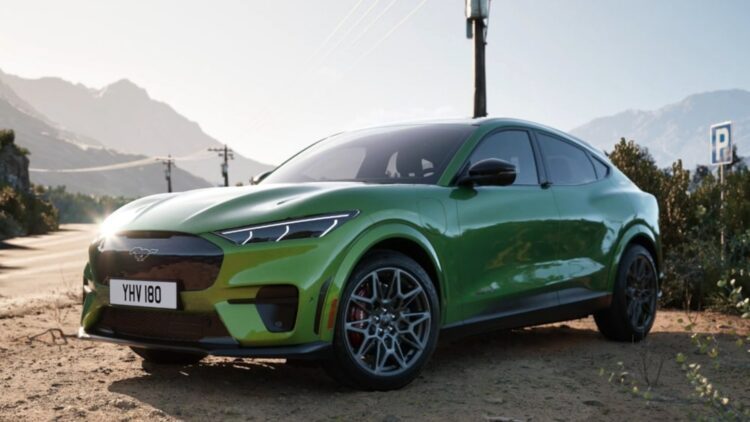
Ford released a statement that left the entire country stunned: a temporary suspension of sales for the Ford Mustang Mach-E, the brand’s favorite EV. Obviously, this measure put the entire automotive sector on alert. The vehicle comes with defects in the electronic door handle system that could trap the occupants inside if the auxiliary battery drops below 8.4 volts. And even if we love living our lives in our cars, not literally…
We’re talking about almost 200,000 units in the United States and more than 300,000 worldwide… The National Highway Traffic Safety Administration (NHTSA) has already published the recall, and the brand is preparing a free software update, but in the meantime, dealers are not allowed to sell the company’s star electric crossover!! Want to know what happened? We’ll tell you below.
Another Ford recall
Yes, as you can see, another (yet another) Ford recall, and in recent years we’ve already lost count. This time it affects many more vehicles than those covered by the NHTSA recall, 120,000 Mustang Mach-E units just in our country, and nearly 300,000 units in the rest of the world have also been called for withdrawal…
Production dates of the vehicles?
Between 02/24/2020 and 06/03/2025
But what’s the issue?
This time, the problem lies in the battery. 12 V, but if it discharges below 8.4 V, the module that controls the electronic handles keeps the last recorded state: locked or unlocked.
When the vehicle is turned off, the DC-DC converter stops supplying the low-voltage network, and if the doors were closed… the car can go from shelter to trap because the external handles become inoperative.
That said, if it helps, from the inside, occupants have a mechanical lever they can use to exit, but once outside, access requires opening the front hood, applying external current to the auxiliary terminals, and restoring the voltage, an unfeasible process in an emergency with children or pets inside…
The NHTSA reaction
The official report (25V404) states that 197,432 vehicles of this model are affected in the U.S. Since November 2023, the agency has received six complaints from families who couldn’t get back into the car with their children inside. NHTSA contacted the brand on January 10, and after investigating four warranty claims and three service reports, Ford issued the stop-sale order but chose not to launch a “stop-drive,” understanding that the risk only materializes after the auxiliary battery discharges and that in reality, the car can be driven without posing any danger to the user.
Ford’s plan:
Ford is still preparing the solution, but everything points to a software update coming soon (although they haven’t specified an exact date yet). Notification letters to users will also arrive soon, starting on September 29, 2025. In the meantime, we won’t be able to buy this vehicle at dealerships.
What else do we need to know?
For now, the NHTSA report indicates that the software update will need to affect the vehicle’s Powertrain Control Module (PCM) and the Secondary On-Board Diagnostic Control Module C (SOBDMC), and of course, it will be free for users.
That means Ford will cover all costs even if users have to make a stop at the workshop (although it’s unclear why it can’t be done wirelessly).
What if I have a Mustang Mach-E?
Well, wait until the software is available. The company recommends keeping an eye on the “System off to save power” warning on the center screen, watching out for a black display or the need to pull harder on the interior handle. If any of these signs appear, the advice is to visit a dealership to check the battery status and, if chronic depletion is detected, replace it immediately.
Ford in check
One more recall for Ford, putting them back in the spotlight of road safety and once again raising doubts about electrification: these vehicles’ systems must ensure basic functions even when there’s no energy in the vehicle, don’t you think?
Be careful with your Mach-E if you drive it, unless you want to be stuck in an electric submarine forever.