
Can you imagine walking on the beach and suddenly you find a fossil? Well, this is what happened to Britta Krause on a beach in Germany. Most people wouldn’t have even noticed it or maybe they would have looked at it and thought it was trash, I mean nobody thinks they’re going to find Prehistoric material walking on a beach. So, imagine thinking about this object being a valuable piece for Palaeontology… Unthinkable.
There are so many things we can know about ancient times from fossils. So, let’s see what valuable thing the woman found and how it was identified.
You’re walking on the beach and you find something strange
Think about a regular day, you go to the beach to relax and walk around while you feel the fresh air and suddenly… you find something strange buried under the sand, what would you do? Some people might leave it there because they may think it is garbage and others are too curious to ignore it. Well, the protagonist of this story decided to have a look and she did very well.
The woman, Britta Krause, found a treasure from millions of years ago in the Lindhört beach located in the Baltic Sea in the north of Germany.
The finding was… a fossil
Britta thought it was some old and damaged piece of plastic, but what she didn’t know is that she was holding a fossil.
When she took the fossil she thought it was something different than plastic because it was very light and it had a peculiar texture and color. So, she took it to the Geological Museum in Kiel where scientist Matthias Alberti analysed the fossil and he couldn’t believe what he was witnessing… an authentic amber!
What’s that amber?
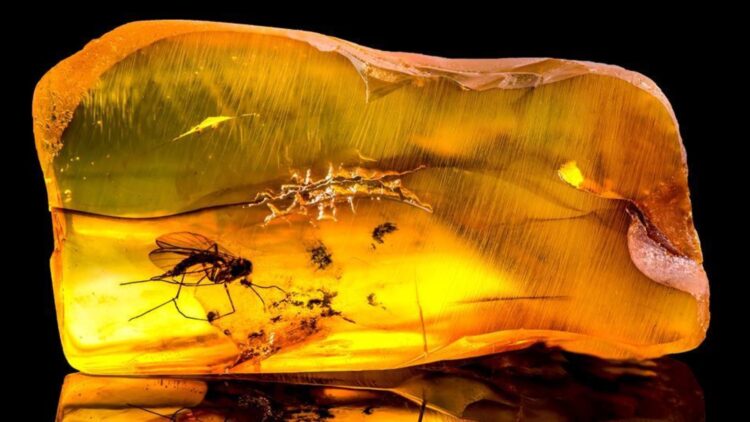
The amber is a Prehistoric material from around 35 million years ago. This is commonly confused with aa rock, but it actually comes from the resin of the ancient trees that has hardened and it became a fossil.
This amber is a source full of information of ancient times about how life was back then. Some ambers can contain insects, leaves or flowers, among many other things, inside the resin when they were still alive or fresh.
The process behind the identity of the fossil
How would Matthias Alberti know it was an amber if this is a rare fossil to encounter? Well, nowadays there are many advanced technologies to analyse many discoveries. He did three tests to prove it was an amber.
First, he tried the floating test because authentic ambers float in salted water whereas most plastic and rocks sink. Once this test was a success, he wanted to confirm his theory by using ultraviolet light (UV light), which would confirm it is an amber by showing a blue, white or green tone – which it did.The last test he tried was its hardness, since the amber is so soft that you can even scratch it with your fingernail.
Did Britta keep the amber?
I’m afraid she did not. The Geological Museum in Kiel has decided to study the amber in detail because of what it could possibly contain inside the resin.
Scientists want to use CT scans to see what’s inside it without damaging the fossil. Thanks to this discovery they could get a new species never registered before or even an extinct species. This will be an important analyses for the Paleontology field to understand the climate and biodiversity from millions of years ago.
Britta said she was so excited about making a huge discovery like this and she will keep walking on the beach to search for more fossils. Life is so curious, isn’t it? You wake up one day and you are going to be an important piece for the understanding and improvement of studies about life in ancient times.