
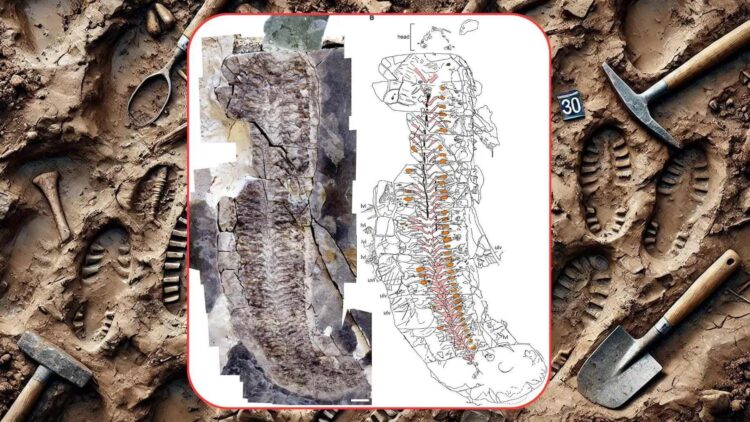
444 million years have passed since this creature roamed our land, and it has spent millions of years buried beneath the Earth. But now, researchers have uncovered it and left the world speechless: no head or limbs, but perfectly preserved muscles, intestines, and tendons. After 444 million years (are we even aware of how long that is?) and buried underground. Fossils are like time capsules, and we’re going to tell you what they’ve discovered about this arthropod that was probably one of the first to walk the planet.
What is this creature?
Meet Sue, a long, somewhat rough lump embedded in a rock extracted from a remote quarry in southern Africa. Officially named Keurbos susanae, but we think Sue is much more endearing, right? It was discovered by paleontologist Sarah Gabott over two decades ago. And you might be wondering, if it was found so long ago, why is it making headlines now? Well, researchers spent years trying to analyze and figure out what species it belonged to. However, Sue is one of a kind (literally), and in 2025, Gabott decided to publish the finding because this discovery holds much more importance than we think.
An inside-out organism
We’re talking about an arthropod, the animal kingdom group that includes insects, crustaceans, and arachnids. However, something unusual about Sue is that it’s “inside-out.” But we’ll explain that now.
Sue, after 444 million years, turned up with its internal parts astonishingly preserved, which is strange because usually, what gets preserved over time are hard shells or bones. But with Sue, everything is differen, there’s no head or limbs, but all of its internal anatomy was found as if it had disappeared yesterday.
How was it preserved?
The secret lies in the geological formation where it was found, the Soom Shale, a marine shale-rich area from the Ordovician period. During that era, certain marine basins became hostile environments for bacterial life due to a lack of oxygen and the presence of hydrogen sulfide (similar to an extreme glaciation that wiped out 85% of marine species). That toxic combination prevented decomposition, allowing the soft tissues to mineralize before vanishing.
Scientists believe compounds like clays and calcium phosphates played a key role in this unusual preservation. So, what normally gets lost (muscles or tendons) was what survived. That’s why we said earlier that this is a “reverse” fossil.
Hard to classify
As we mentioned, Sue has no other species companions, and the authors of the study agree that Sue is a primitive marine euarthropod, but its place on the evolutionary tree is a complete mystery, since all the external parts used for identification are missing, placing it near other species based on evolutionary relationships is nearly impossible.
So what do we know about Sue?
The only confirmed fact is that its trunk is segmented, suggesting it once had limbs. Were they legs? Fins? No one knows for sure. But what’s clear is that this creature lived in an extreme environment and survived the passage of time with its insides intact.
A very personal story
It’s been more than two decades since Gabott discovered the fossil near the Cederberg Mountains, when she was just starting her career, and she has spent nearly a quarter of her life trying to piece together this discovery. But the logic never came together. Gabott wanted to name the fossil after her mother, and it was her mother who pushed her to finally publish her study: “Sarah, if you’re going to name that fossil in my honour, do it before I end up in the ground myself, fossilized,” she told her. That was the push Gabott needed to go ahead and publish this incredible discovery.
Now, Gabott is doing what she loves the most, she continues to dig up rocks and tries to figure out how these amazing creatures lived on our planet millions of years ago.
What do we know about evolution?
Now, it seems like much less than we thought. How many other primitive species have we missed simply because they didn’t leave behind hard parts? Most studied fossils are based on skeletons or shells. But Sue shows us there may be a whole universe of soft-bodied fossils waiting to be discovered, invisible to traditional methods. So, an incredibly vast new area of research has opened this year: paying more attention to fossils with soft tissues. What an incredible and curious world we live in.