
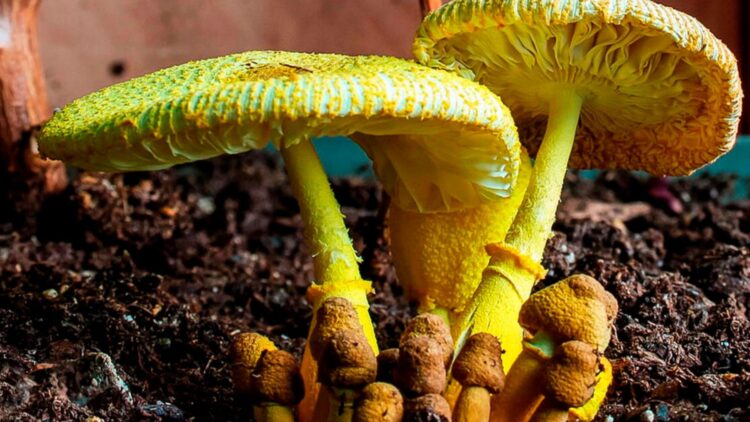
Gold that comes from fungi. Sounds like the craziest thing you’ve ever heard, right? Well, it’s not a made-up story or some curious kid’s wish to a genie. A team of Australian scientists has found a fungus that can absorb gold, grow faster in the presence of the metal, and stick it to its structure as if it were part of its body. What? Exactly, like Mr. Potato but fungus version… and with gold!
They discovered it at the CSIRO (Australia’s scientific agency), and what looked like a simple lab finding could forever change the way gold is searched for and extracted.
Yes, you read that right: a fungus that gets along well with gold. It incorporates it as if it were its own!
Traditional geology, turned upside down
Gold has always been searched for with pick and shovel. Rivers, mines, meteorites… but no one had thought to look underground for fungi. Until now.
What the scientists discovered is that a fungus very similar to Fusarium oxysporum not only withstands gold: it loves it. It grows better when the metal is present and, as if that weren’t enough, it ends up decorating its structure with tiny gold particles. Just like that, with no apparent effort!
Dr. Tsing Bohu, who leads the study, explained it like this: gold is a chemically inert material, very stable, and that’s why this behavior challenges everything we thought we knew about how it interacts with living organisms. Basically, nature just exposed us.
Growing gold? Not as crazy as it sounds
Although they are still researching how all this works, they’ve already seen that some strains can form gold nanoparticles as a response to certain stimuli. In other words, they don’t just trap it: it seems they can transform it. There’s even another species, Candida rugopelliculosa, that has also shown this ability under stress conditions.
So we’re not talking about an isolated case, there could be a whole family of fungi with this superpower.
A way to do mining without destroying everything
And here’s where things get (more) serious. Mining companies are already paying attention, it’s normal. Because extracting gold today means moving tons of earth, using toxic substances like cyanide, consuming a lot of water and leaving the landscape destroyed, it’s a disaster… But if fungi can act as living sensors (marking where the gold is without needing to dig anything), the change would be radical.
And if the process can be scaled at some point… we’d be talking about biological mining, much cleaner, more precise and without the side effects of the current model! Remember our Earth is dying fast… This could be an incredible option to save (or at least, to try) our planet!
The challenge now: making it work outside the lab
But wait, next step is to understand how to grow this fungus in real conditions. What kind of soil it needs, humidity or pH, how it gets along with other minerals or bacteria… everything counts now!. Is it possible to be reproduced on a large scale?
It’s still too early to draw conclusions! But the mere fact that something like this exists is already a revolution.
The revolution is underground (literally)
We don’t know if in five or ten years we’ll see mines without excavators, without cyanide and without polluted rivers. But this opens a door that we didn’t even know was there. A gold-producing fungus isn’t just a scientific curiosity: it could be the first step toward a more sensible, cleaner kind of mining, more in tune with the environment.
Nature, once again, shows us that it had the solution right under our noses. We just had to bend down a bit and look at the ground