
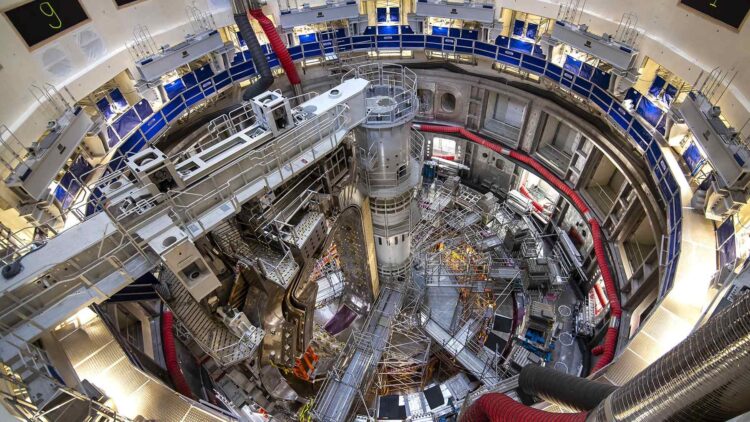
A step forward for fusion energy! The biggest project in the history of humanity is going into a decisive stage, we are talking about ITER. This is a huge scientific experiment that aims to create fusion energy, the same energy the Sun and the stars produce. Its goal is to obtain a source of clean energy, safe, and practically limitless for the future.
The ITER reactor is being built in Cadarache, the south of France, and 35 countries are collaborating in this project. Among them we can find: United States, China, Russia, Japan, India, South Korea, and countries from the European Union. All of them contribute in some way to make this project possible. So, let’s learn more about it.
Westinghouse
In August of 2025, the ITER project started a key stage: the final assembly of the reactor’s core, also known as the tokamak. This stage is led by the American company Westinghouse Electric Company, which received a €168 million contract to handle this extremely precise and difficult task. What they did was to precisely join huge steel pieces (400 tons each) that will make the vacuum vessel, where the fusion energy will take place. Inside, it will contain plasma — a super-hot gas heated to more than 150 million degrees Celsius, even hotter than the core of the sun. In that plasma, light atoms will fuse together to release enormous amounts of energy, the process that creates fusion energy.
Westinghouse doesn’t work on its own, it has been collaborating in ITER along with Italian companies like Ansaldo Nucleare and Walter Tosto for more than 10 years. Together, they have already manufactured 5 out of the 9 sectors of the reactor.
A unique global project
ITER is a unique example of how nations can work together toward the same goal. In total, 35 countries took part in the project, which is more than half of the global population and most of the global economy. Each country builds specific pieces and send them to France, for example:
- Europe provides the construction site, the buildings, and almost half of all components.
- The United States supplies the central solenoid magnet and cooling systems.
- China contributes correction coils and power-supply equipment.
- Japan produces large toroidal field coils and the solenoid conductor.
- Russia provides magnetic field coils and advanced diagnostic tools.
All this collaborative work forms a global scientific chain in which every single piece is manufactured with an extreme precision before it reaches the reactor.
Proving that fusion energy is possible
The purpose of ITER is to prove that fusion energy can produce more energy than the amount it consumes. The reactor is designed to generate 500 megawatts of fusion power using only 50 megawatts of input energy, which means an energy gain of ten times more.
However, the project has faced many challenges since the beginning in 2010 because of: technical issues, manufacturing and coordination delays between so many countries have made the dates change several times. The goal was to achieve the first plasma in 2018, but now it’s expected that major testing with deuterium-tritium fuel could begin around 2035.
Closer to the future of energy
Even though ITER doesn’t generate electricity for electric networks, its role it’s crucial because it will be used for preparing the way for the future reactors called DEMO that will produce electric energy at a huge scale. Fusion energy has several important advantages:
- It creates no long-lived radioactive waste.
- There is no risk of a nuclear meltdown.
- It uses hydrogen isotopes found in seawater, an almost limitless fuel source.
Thanks to this, fusion energy could feed humanity for millions of years without damaging Earth. So, ITER is more than a machine, it’s a symbol of cooperation, hope, and common desire to find a source of clean and limitless energy for future generations.