
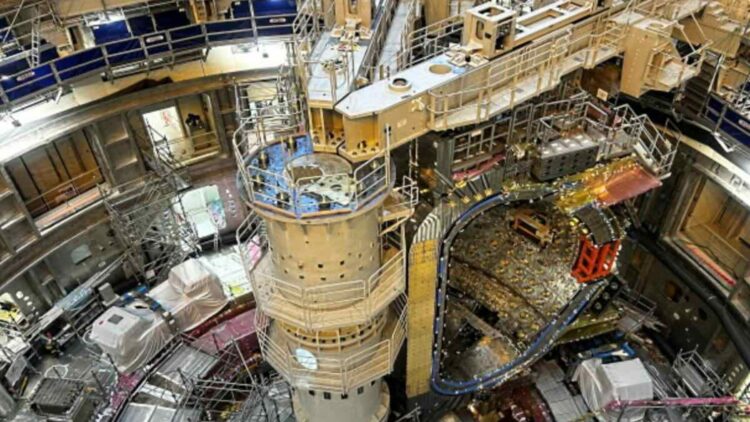
Fusion energy has always sounded like something out of a movie. Recreating on Earth the power that fuels the Sun?? What is that? Well, wait, because this crazy idea is about to “explode” (no pun intended). The project is called ITER, and it is the largest international scientific experiment in history. Yes, the assembly of its core has already begun (the most delicate and decisive part of the entire reactor), and if everything goes as planned, we could be facing the invention of the millennium.
The operation is led by an American company specialized in high-precision engineering, and we are going to tell you everything we know.
What is ITER
ITER (International Thermonuclear Experimental Reactor) is a massive experiment located in the south of France. Its goal is to build the first fusion reactor capable of generating more energy than it consumes.
What is fusion?
It is the opposite process of nuclear fission. Instead of splitting atoms, it joins them, combining deuterium and tritium nuclei (variants of hydrogen) to release an amount of energy similar to that produced inside the Sun. If this process can be controlled on an industrial scale, it would provide a practically inexhaustible source of energy, with no CO₂ emissions and minimal waste.
No room for error
The phase that has just started involves assembling the core of the reactor, a gigantic structure made up of parts that must fit together with millimeter precision. Thousands of technicians and engineers from all over the world are participating in this stage. It is a shared project.
The core combines superconducting materials that must be kept at temperatures colder than outer space with plasma that will reach over 150 million degrees, ten times hotter than the center of the Sun.
Who is participating?
The European Union, the United States, Russia, China, Japan, South Korea, and India. Each partner contributes funding, technology, and components. With a budget of more than 22 billion euros, it is the most expensive scientific project ever undertaken, even above the International Space Station.
Before turning on the reactor
This assembly work is the first step toward carrying out the first plasma tests, although that will not happen immediately, maybe in a few years.
What are the challenges?
For fusion to work, the plasma must remain stable long enough for the energy released to exceed the energy invested in heating the fuel. To achieve this, colossal superconducting magnets and ultra-precise control systems are used. In addition, tritium is very scarce, so the reactor itself will have to produce it through a system of lithium blankets.
What is really at stake
If ITER succeeds, it could revolutionize the global energy landscape. It could provide clean, abundant, and constant energy, without relying on fossil fuels or weather conditions, and without the dangerous waste produced by fission power plants. We would be talking about one of the best innovations we could ever have, don’t you think?
Beginnings are always incredible, and this one, in particular, has the scientific world holding its breath. Who knows if we will be able to master energy this way and manage to slow down climate change?!
To summarize:
- The goal is to replicate the sun’s fusion process on Earth.
- 35 nations are contributing components
- Delays have pushed full fusion experiments to 2035
- ITER will serve as a proof of concept for commercial reactors like DEMO
- Fusion is clean, safe, and sustainable, abundant and accessible.
ITER represents a milestone for humanity, proving that countries can work together to tackle global energy challenges.