
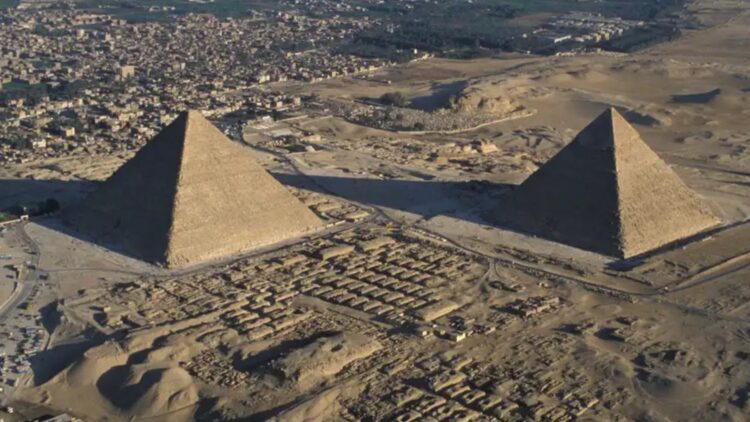
The Great Pyramid of Giza just got even more mysterious than ever. We’ve all heard how much we love Egypt and how interesting it is, but how much do we really know about this ancient civilization? For centuries, we assumed the Great Pyramid had four smooth, perfectly flat sides. Four flat walls, perfectly aligned. But it changes from now on.
Recent researchers from Japan have confirmed a detail that had gone unnoticed even by those who’ve studied the structure for decades!!: the Great Pyramid has eight sides. Yes, eight. Each of its four faces is slightly indented at the centre, creating two distinct angled planes per side. It can only be seen from the air and under very specific lighting conditions… And no, it’s not a construction flaw or a result of erosion. According to Japanese physicist Akio Kato, the concavity was intentional, which makes it even more fascinating to study.
The ancient Egyptians designed it this way with a purpose: as a structural reinforcement to help the pyramid better withstand earthquakes, erosion, and who knows what else. Here’s what they’ve discovered so far:
Eight sides you can’t see from the ground
From the ground level, the pyramid still looks like it only has four sides, as always. But from a plane, or during an equinox, when the light hits just right and gives the whole thing a mystical aura, the vertical line that subtly divides each face can be seen, showing something never seen, incredible.
British pilot first had already photographed this in 1927, but no one paid much attention to him. Now, with modern technology, has it been confirmed that this division is no accident: it’s part of the original design.
So what’s the purpose?
The team from Kanagawa University calculated that the indentation slopes in at about 11 degrees. That’s enough to help the massive stone blocks compress together instead of pulling apart during an earthquake or under internal stress. The structure was built to last and it clearly has: it’s been standing for more than 4,500 years.
Tell me more about it!
Another theory is that this eight-sided shape isn’t just for practical reasons. What if it was meant to be seen from the sky? That theory fits with how Egyptians aligned their temples and monuments with astronomical events, for example with the Orion’s Belt. This pyramid wouldn’t be an exception, of course! There’s plenty of documentation showing how it aligns with stars, the sun, and equinoxes. The study doesn’t go into esoteric interpretations, but it’s easy to imagine this shape might hold symbolic meaning.
Could the shape have another use?
It’s been suggested that the slight concavity may have helped direct rainwater or create the illusion of perfect symmetry when viewed from a distance. What’s truly mind-blowing is how they achieved all of this without modern tools, just ropes, wooden rulers, and water levels. They designed a structure with millimetre-level precision. “Miraculous” doesn’t even begin to cover it, and honestly, it’s no wonder there are conspiracy theories about how the pyramids were built when discoveries like this keep popping up.
What about the other pyramids?
While other pyramids, like the one at Meidum or the step pyramid of Saqqara, have collapsed or needed restoration, the Great Pyramid remains standing, almost untouched. And part of that endurance lies in details like this: subtle concave designs, hidden corner sockets, and the strategic placement of every block so the whole structure works with gravity, not against it.
It’s still a riddle, which is what makes it so fascinating. The Egyptians weren’t just skilled with stone. They were geometry geniuses, and they didn’t need computers or lasers to pull it off.
The Great Pyramid of Giza continues to surprise us. And maybe that’s the most impressive part of all, after more than four millennia, it still keeps secrets. And just when we think we’ve seen everything… a new face appears. Literally.