
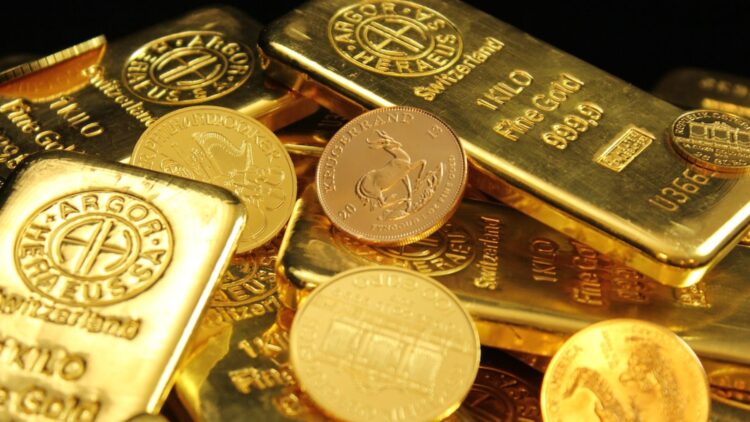
What’s the first thing that comes to your mind when I say the word ‘gold’? Many people would say jewelry, coins and shining gold bars. However, we are not going to talk about any of these, this precious metal is the protagonist of a discovery that has shocked the scientific community (and that says a lot having in mind the many things scientists have seen).
We all know that if you heat something enough,it melts, but this doesn’t happen with gold, which can stay solid even at extremely high temperatures. Why didn’t gold become liquid? Let’s find out.
Scientific discovery
A team of international researchers used ultrapowerful and very fast lasers to heat small pieces of gold, because they wanted to see what happened when this metal reached temperatures beyond its limit. What happened? Gold resisted more than expected before it melted. Instead of turning into liquid right when it reached its fusion limit, it stayed solid for a small amount of time – enough to prove our current models on how matter behaves under extreme conditions needs to be reviewed.
Scientists got to heat gold up to 19,000 Kelvin (more than 18,700 degrees Celsius). Let’s compare it to something, so that you can have a clear picture of what we are talking about: the Sun is pretty hot, right? Well, the temperature this metal reached was even hotter than the Sun! Even though it reached that temperature, the gold held its structure for over two picoseconds (a trillionth of a second). I know it seems like nothing, but in the scientific community this is a record. It’s unbelievable!
Superheating phenomenon
This strange behavior of gold can be explained thanks to a phenomenon known as superheating. Normally, when you heat something that it’s solid, its atoms start to move faster until the structure is a mess and the object becomes liquid. However, if you heat it up too fast, the atoms don’t have time to react and the material keeps solid (although it exceeds the fusion limit).
Until now, experts thought there was a hard limit called ‘’entropy catastrophe’’, which means temperature in which no solid could resist and had to melt. It was believed this limit was three times the fusion limit of a material. Thankfully, this gold experiment proved it can last up to 14 times more without becoming liquid.
What about other materials?
It is true this experiment mainly focused on gold, but researchers are already planning on making new similar tests with other solids. This way they can answer questions like: will these materials be capable of resisting more than we think too? or are there any materials with no fixed fusion limit if they are heated fast enough?
If scientists can answer these types of questions, it could mean a revolution in the physics of materials and it could give us new tools to face future technological challenges.
Importance of this discovery
Some people might think that scientists melting gold to see what happens is a silly thing, but it is actually really important for understanding how gold and other materials behave under extreme conditions. This can be very helpful for:
- Better understand asteroids crashes in space, which generate extreme temperatures and pressures.
- Optimize nuclear reactors where materials should resist critical conditions.
- Design new advanced materials capable of dealing with extreme conditions in the industry, space exploration or even medicine.
Who would have thought melting gold just to see what happens could be so important for the future? Now we know gold is not just a symbol of richness and beauty, it’s more than that: a key point in modern science.