
Plastic waste and the difficulty of extracting and eliminating it from nature has become one of the greatest challenges facing humanity. Added to this is the need to generate more renewable and clean energy, both industrial and domestic. These are two problems that require urgent solutions and for which numerous research projects are underway, some of which even propose solving both problems with a single invention.
In just 20 years, the world’s annual production of plastic waste has doubled, from 180 million to more than 350 million tons, according to the OECD’s World Plastics Outlook report. In Spain, less than 12% of this waste is recycled.
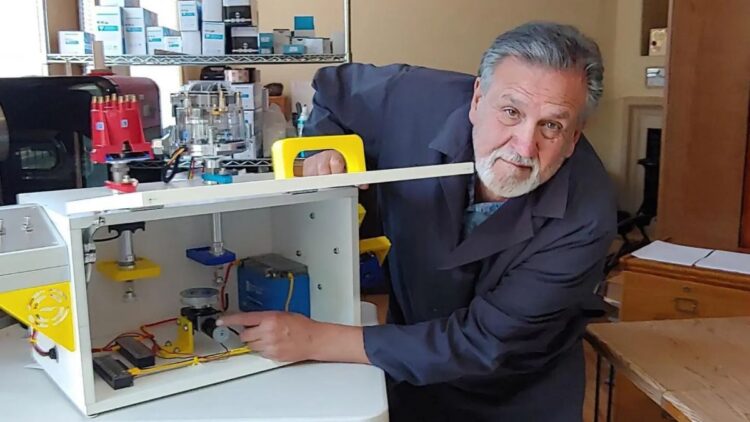
The same thing is happening in other countries where there are people who are increasingly aware of the problem, like the inventor of this product, CarisMatic, a small generator the size of a shoebox that converts plastic into electricity to light the home at night, charge the car battery, or on a larger scale on an industrial scale. The company that this engineering veteran has built from his invention aims to clean up the planet while providing clean energy.
A shoebox
Years ago, Dan Caris ran into a problem that many people can relate to. He had some commercial printer cartridges and when he went to recycle them, he was told that they could not be recycled and the cartridges ended up in a landfill. This simple gesture made Caris aware of the global problem of plastic waste today, and he set out to find a solution.
More than 99% of plastic is made from fossil fuels – mainly oil and gas – and recycling it is complex. It is essentially hardened fuel, so this inventor decided to come up with a way to extract that energy. “Not only will it produce energy, but it will also produce near-zero emissions by using existing carbon capture technology,” the project says.
The prototype is designed as a shoebox, “smaller than most air conditioners,” they say. The device is autonomous, designed with existing technology and, according to its inventors, requires only a handful of the world’s most common waste: plastic. Their intention is to create different models with different sizes so that they can serve as a home generator or on a larger scale.
Although its inventor is now an elderly man, it took him more than 10 years of work to develop this machine to the point of patenting, and he has 40 years of engineering experience behind him.
This is how it works
After securing patents in 2022, the inventor revealed that the generator is composed of eight to ten independent systems, a combination of electrochemical, thermal and mechanical. The invention does not require any other type of fuel or energy source, only plastic waste such as bottles, bags and other products that end up in the recycling bin at home.
The machine produces a cloud of pulverized plastic that is heated to high temperature in a ceramic chamber, this passes to a heat exchange unit where the steam that is generated to turn a turbine and thus end up producing electricity. The turbine is a boundary layer turbine, an invention of Nicola Tesla in 1913, and its main characteristic is that it does not use blades.
Once this process is complete, the superheated plastic is reduced to a molecular level where it is chemically combined with a converter. The company mentions carbon capture, a process widely used by the most polluting industries, such as electricity, and applied in other green initiatives.
The company does not specify the capacity of its current prototype to generate electricity based on grams of recycled plastic. Although the company’s plan was to start manufacturing the first units at the end of last year, this project is still far from being finalized, the company’s latest publications show that the design is still evolving: instead of using ceramics, the engineering team has opted to improve it with anodized aluminum.
Other similar projects
The Caris generator is not the only invention that has been proposed in recent years to achieve two noble goals: the elimination of plastic waste and the generation of clean energy. Since the sea is one of the places where the pollution of this material is most worrying, several projects have proposed to propel ships by converting waste into energy.
In general, these inventions work in a similar way, for example by means of hydrothermal liquefaction. This allows waste such as plastic to be converted into a biofuel by heating and depolymerizing the material at temperatures up to 500º C and pressures 250 to 300 times higher than sea level.
In other cases, nets or boats are simply designed to collect debris from the sea. By separating plastic waste from other waste such as glass, the former can be converted into fuel at sea and the latter can be taken to recycling facilities on land.