
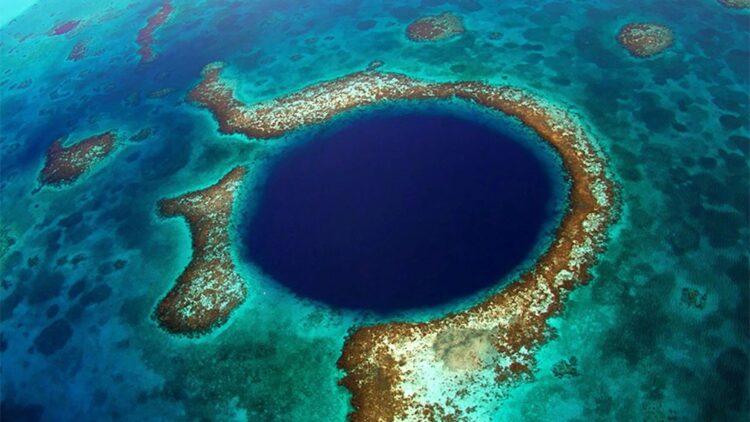
Have you ever heard of the Great Blue Hole? In case the answer is no, you have to know it hides secrets… In the middle of the Caribbean Sea, in front of the Belize coast, there is a place that looks as if it were taken out of an adventure movie. We are talking about the Great Blue Hole, a blue hole whose shape is perfectly rounded, and it has become one of the most attractive destinations for divers and explorers all around the world.
Not only is this place a beauty of nature, but also hides secrets that science is still trying to find out about. So, let’s learn more about the Great Blue Hole, shall we?
The Great Blue Hole
This is a huge underwater drain located in the Lighthouse reef, about 70 km away from the Belize coast. The Great Blue Hole is more than 300 meters of diameter and it’s around 125 meters deep, which makes it one of the largest and most famous underwater holes in the world. That’s a great title.
This famous place was formed thousands of years ago, during the last ice age, when the sea level was much lower. At that moment, limestone caves were exposed to air and, with the passage of time, they sank when the sea rose. The result? The Great Blue Hole, which attracts scientists, tourists and professional divers nowadays.
The explorer who made the Great Blue Hole famous
Before it was known worldwide, the Great Blue Hole was already known by local fishermen. However, there was a man who made it a thing for the rest of the world, this man is the legendary French explorer Jacques Cousteau. In 1971, this explorer arrived on his boat (the Calypso) in the Great Blue Hole and he declared it one of the best places for diving in the whole wide world. Since this moment, thousands of adventurers have travelled to Belize to admire its deeps and discover what it hides.
What a drone found
Recently, the content creator called Will Mitchell decided to explore the Great Blue Hole in a different way: using an underwater drone with a GoPro camera. What he recorded shocked scientists and curious people on the internet, and I’m sure it will surprise you too.
During the first meters of the recording, you can see a marine landscape full of life: colorful fish, vibrant corals, and an ecosystem similar to those we see on documentaries. However, as the camera got deeper, everything changed.
Around 90 meters deep, everything was dark, therefore, the amount of fish lowered and the beautiful landscape turned heartbreaking. No fish, no corals, and silence; it looked like a whole new world (and we are not talking about Aladdin’s song).
Mystery and science in the blue hole
Beyond the spectacular images, the Great Blue Hole is a natural lab for scientists. Thanks to its isolation and depth, they can study how Earth was a thousand years ago.
In the inside of the Great Blue Hole they found stalactites that confirmed this place’s origin as a terrestrial cave. What’s more, they could see layers of hydrogen sulfide which means there’s almost no life down its deepest areas.
Exploring the Great Blue Hole has been useful for analyzing climate change effects and the rise of the sea level in coastal ecosystems.
A touristic place, but respecting nature
Nowadays the Great Blue Hole is one of the most attractive tourist places of Belize, every year thousands of people visit it. However, if you are willing to go there, you should know the visit requires experience and caution because the depths hide dangerous currents.
Experts insist on the importance of visiting the Great Blue Hole with responsibility, respecting the ecosystem and avoiding any harm to the coral reef around it.
The enigma keeps going
It’s true science has made some advances in its study, but the Great Blue Hole continues to be a mystery. Its beauty, geological history and the feeling of being in front of something nature made thousands of years ago; make the Great Blue Hole one of the most fascinating places on Earth.
We don’t know if it will be possible to know what the Great Blue Hole hides, but, as time passes, more people are interested in this place. Would you like to visit it?