
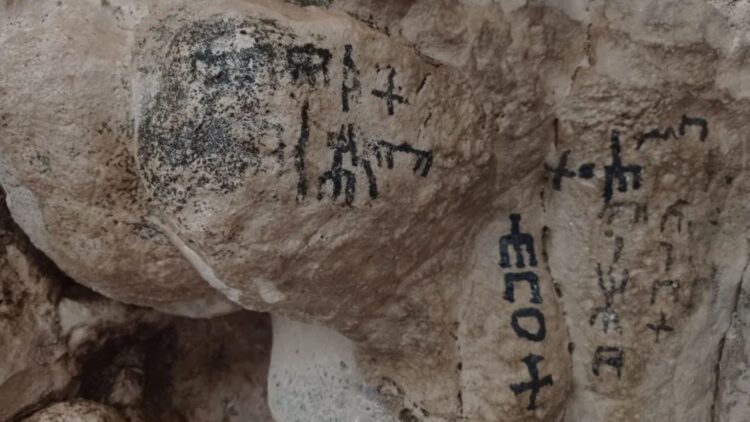
Every once in a while, history solves a mystery when someone comes along with the missing piece that helps us understand the past. One of the latest breakthroughs has happened in the deserts and mountains of Oman, Yemen, and the island of Socotra. There, carved into rocks and hidden in caves, researchers had long seen strange markings that no one could read.
Now, thanks to the work of scholar Ahmad Al-Jallad, the code has finally been cracked. His research has brought the ancient “Dhofar script” to life, solving a riddle that had confused experts for more than 100 years. So, let’s learn more about this mystery.
A mystery in the Arabian Desert
The story begins about 2,400 years ago in the Dhofar region of southern Oman. Explorers and archaeologists had found inscriptions scratched into stone surfaces, they were clearly a form of writing. But unlike Egyptian hieroglyphs or Mesopotamian cuneiform, no one knew how to read them.
Over the decades, some researchers tried to guess the sounds of the signs by comparing them with other scripts from Arabia. But nothing made sense. The only clue they could identify was the word for “son of,” which appeared in family names. Beyond that, the Dhofar script remained a stubborn mystery.
The breakthrough: Three abecedaries
The turning point came when three special inscriptions were studied more closely. These were abecedaries — basically, ancient alphabet charts where scribes practiced writing the letters in order. Imagine finding a child’s notebook where they wrote A, B, C, D… That’s what gave Al-Jallad his “aha” moment.
By carefully analyzing these sequences, Al-Jallad reconstructed an alphabet of 26 signs. Suddenly, what had been unreadable scratches began to reveal real words.
First words from the past
With the alphabet in hand, scholars could finally read short inscriptions. They discovered:
- br, meaning “son of,” used in genealogies.
- ḥwg, meaning “to need or desire.”
- ḥmd, meaning “to praise or thank.”
Some inscriptions even called upon gods, like Shams, the sun deity, asking for long life or divine help. For the first time, the voices of people from ancient Dhofar could be heard across 24 centuries. The mystery had turned into a conversation with the past.
Why this matters
At first, an old desert script carved into stone might not look like a big deal — but this discovery is far more important than it seems. Experts found that the Dhofar script is connected to South Semitic writing systems, yet its letter shapes also borrow from North Arabian traditions. This mix points to a lively cultural exchange in ancient Arabia.
The language behind the script is similar to modern South Arabian tongues like Mehri or Soqotri, but not quite the same. It may even represent a completely lost language that vanished centuries ago.
Most striking of all, the Dhofar inscriptions show that the people of this region had their own written tradition, different from the grand stone carvings of southern Arabia and the rough graffiti-style scripts of the northern deserts
More mysteries ahead
Al-Jallad’s work focused on what he called “script 1a.” But there are still other versions, including a “script 2,” that remain undeciphered. Some inscriptions contain strange symbols that don’t fit the alphabet we now know. These may represent other writing systems or later changes to the Dhofar script. So, the Dhofar script may have given up part of its secret, but plenty of mystery remains.
A window into the past
Isn’t it amazing how we can have a look at how people once lived? These inscriptions show they prayed, gave thanks, and recorded family ties; the same human concerns we have today. Through the cracks in the desert stone, we can now see a little of their world.
Somewhere out there — in deserts, caves, or mountains — the next big mystery might already be carved into stone, waiting for someone to read it.