
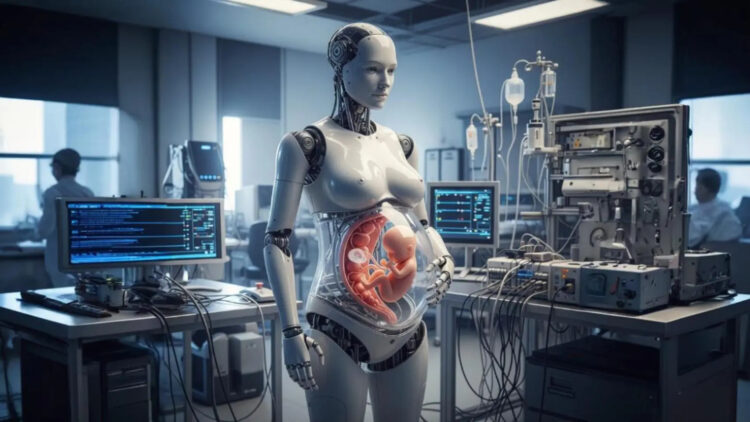
There are robots for everything, and, far from looking like we are at the center of the technological era, some are a little scary, creepy. And maybe you haven’t seen I, Robot, but some of us are too millennial to understand some of the news that keeps coming, like this one. Science in China has just created a humanoid robot with an artificial uterus capable of simulating a complete pregnancy. We told you, creepy. And yes, China is a country where infertility affects almost 20% of the population and this could be the way in which millions of couples who dream of becoming parents can achieve it, but yes, it still seems strange to us (where would the mother-fetus bond be if babies are generated in portable uteruses?)
Relax, the project is still in the experimental phase, but of course, there has already been a big debate on social media, yes, it is a hope for those infertile people, but what about the ethical dilemmas?
The robot that simulates a human pregnancy
The team led by Doctor Zhang Qifeng has developed a prototype of a humanoid robot with an artificial uterus that, in principle, works. This device is designed to carry out a complete pregnancy, from gestation to birth.
Although it is not yet available on the market, it is in an advanced research phase and scientists assure that soon it could become a tool for reproductive medicine.
How an artificial uterus works
The system uses synthetic amniotic fluid that reproduces the natural environment of a pregnancy. During the usual 40 weeks of gestation, the fetus would receive nutrients through a tube that would imitate the way a mother’s body nourishes her baby. An artificial intelligence would be in charge of controlling the process, monitoring the growth and health of the fetus as if it were a real mother.
It is strange, we know, but it still remains to be solved how the fertilized eggs will be implanted inside the device, one of the unknowns that keeps the scientific community on edge.
The Biobag in the United States
The concept was already seen in 2017, in Philadelphia, the Biobag was presented, a device that works like an incubator for extremely premature babies (babies that are born early). This is a sterile polyethylene bag that imitates the amniotic sac and allows the vital organs of the baby to develop for several weeks, almost like the pouch of kangaroos.
But of course, the Biobag is not a humanoid robot that wants to gestate babies. Has technology gone too far for us?
The debate
Of course, technology would reduce the risks of a human pregnancy and could prevent complications during childbirth, but… we have seen so many robots of so many kinds (some we wish we hadn’t seen…) that really quite important doubts arise for us. Isn’t it essential for the affective and psychological development that is formed through the emotional bond with the mother? Are they AI fetuses? What will their rights be? And above all… where are they going to get eggs from!??
Between hope and controversy
Some celebrate a solution to the problem of infertility in China and in the world, but others see it as a threat that challenges the very nature of motherhood.
And you, what do you think about the development of a humanoid robot with an artificial uterus? Do you think it is replacing women’s bodies? Do you think it is ethical?
Yes, we also love technology but the debate mixes science and ethics, and it can mark a before and after in human life itself, don’t you think?