
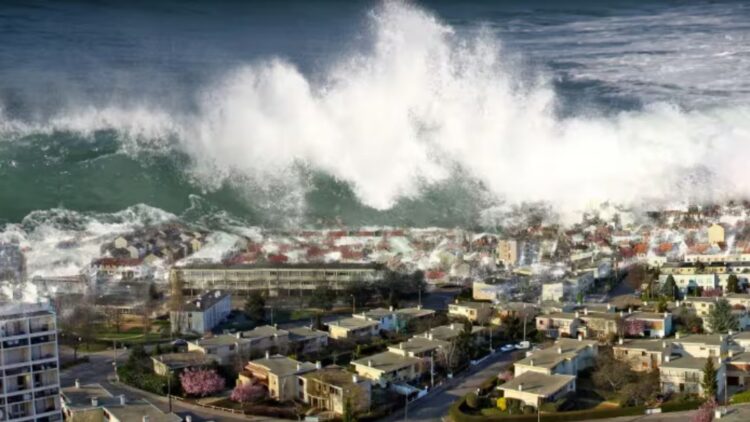
If we thought we had seen it all when it comes to atmospheric phenomena, scientists have calmed us down quite a bit with their latest report (spoiler: no). They have just warned that a megathrust earthquake could happen soon in the United States, specifically in the coastal area of the Northwest, which could affect the regions of Washington, Oregon, and Northern California. The reason? Rising sea levels due to climate change.
The report is led by geologist Tina Dura, professor of geosciences at Virginia Tech, and she is quite clear: there are zones that are in the so-called “geological window of possibility.” What does that mean? That this area is more likely to suffer from unpredictable atmospheric phenomena, especially with the rise in sea level. What is happening?
The threat: more real than ever
This professor said what is going to happen is “imminent.” It has been more than 300 years since the last major earthquake in this area. The worst part? The expected effects are much more devastating than those of Japan in 2011 and Sumatra in 2004, according to her.
Is there an exact date for an earthquake?
No, not yet. It is “imminent” because it can happen at any moment, tomorrow, next week, or in twenty years.
The Cascadia Fault: what is it?
That’s the name of a massive subduction zone that stretches off the Pacific coast, from Northern California to British Columbia.
Now let’s do a memory exercise, do you remember when you had to study tectonic plates and their movements in school? Well, here the Juan de Fuca plate and the North American plate converge. The first one is slowly and gently sliding under the second, building up tension more intense than when you run into your ex.
What will it cause?
That the tension will explode, sooner or later, and cause a major earthquake, potentially reaching magnitudes of 8.0 on the Richter Scale. And not just earthquakes, if the seismic movement happens underwater, it could trigger large tsunamis like the one in Sumatra in 2004 or the one in Japan that wiped out entire communities.
When was the last one?
The last recorded one was in 1700. More than three centuries have passed, which is why scientists think it could happen very soon.
Climate change = worse possibilities
That’s right, the main “culprit” is the rise in sea level, a direct consequence of the melting poles due to the sea level rise. Of course, this could worsen the effects of the earthquake (or megathrust earthquake as experts have classified it), since the most affected areas will be the coastal ones (which, almost as a rule, are very difficult to evacuate).
Can we do anything to prevent it?
No, earthquakes happen and there is hardly any clear prediction, it’s not like hurricanes. Despite that, prevention and preparation will be crucial and the only viable ways we have to survive. What do these measures involve? Very simple, earthquake-resistant structures, evacuation plans for the most populated coastal areas, and of course, alerting the population so they can act as quickly as possible.
What is the Richter Scale?
It is a system used to measure the magnitude of an earthquake (that is, the amount of energy released from its origin point). The strongest earthquake recorded since this method has been used was on May 22, 1960, exactly 55 years ago. It was recorded in Valdivia (Chile) and left up to 6,000 dead.
What happened in 1700?
The Cascadia earthquake of 1700 was one of these megathrust earthquakes we mentioned. Its estimated magnitude was between 8.7 and 9.2, and it occurred in January 1700. This earthquake took place under the North American plate, and even though written records of these events did not exist at the time, the oral traditions of Indigenous peoples described this earthquake as a great flood that devastated entire communities, leaving very few survivors.
That’s why it is vital for the population to be aware of the risks and be prepared, not for a zombie invasion, but for a real problem: megathrust earthquakes.