
Our universe doesn’t give us a day’s respite, and now it seems that the probability of an asteroid hitting Earth has increased. This is asteroid 2024 YR4, which has gone from being just another rock floating in the cosmos to becoming a priority for NASA and the European Space Agency (ESA).
The main reason is that the probability of impact with Earth has increased in a matter of days, going from 1.6% to 2.3%. Although it may seem like a low figure, in astronomical terms it has been enough for the international team of astronomers to activate emergency observation protocols.
The scientific community has approved a special mission for the James Webb telescope to analyse in detail the orbit, size and thermal behaviour of this asteroid. Is it really a threat? What would happen if it hits Earth? We tell you everything.
What is the James Webb?
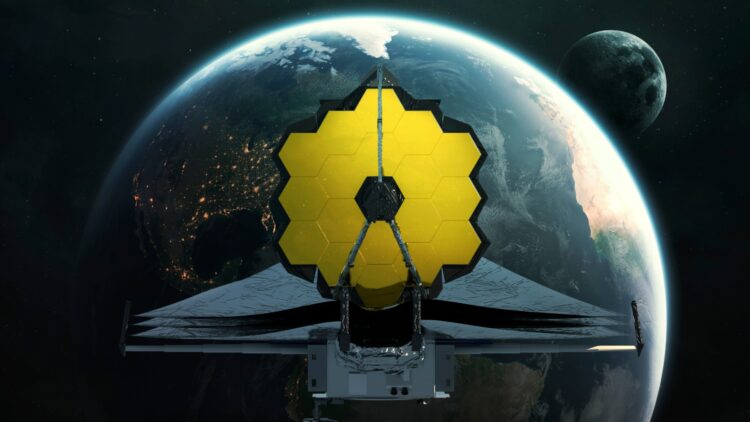
The James Webb Space Telescope (JWST) is the most advanced telescope ever built, a joint project of NASA, the European Space Agency (ESA) and the Canadian Space Agency (CSA). It was launched in 2021 and replaced the capabilities of Hubble (another telescope).
This telescope is located in space, and its main objective is to study the early universe (you already know that looking through the universe is like watching an old movie), so, with this invention you can observe the first galaxies that formed thousands of years ago after the Big Bang.
It is located 1.5 million kilometres from Earth, at the Lagrange point L2, this site allows it to remain stable so that observations can be made without interference. And best of all, this telescope can see through cosmic dust because it has infrared radiation with which it detects exoplanets, nebulae and black holes from other systems.
What do we know about Asteroid 2024 YR4?
For now, it was discovered last December and is the size of a building (approximately 55 meters wide), and has a 1 in 43 chance of impacting our planet in the next 7 years (initially it was 1 in 83), so this has set off alarm bells throughout the community and has positioned 2024 YR4 at the top of the Sentry risks (the list of risky objects in the universe) for our planet.
But does it represent a risk?
Knowing the size of this rock will be key to determining the possible risks. If you are wondering why this mission has been considered a priority, it is because it can do a lot of damage to the population that falls.
Obviously, it will not cause an extinction of races as occurred with the dinosaurs and the Chicxulub asteroid, but a tragedy could occur that would cause regional havoc as in the Tunguska event (an asteroid fell on Siberian lands and destroyed more than 2,000 square kilometres of forest, causing a detonation equivalent to 10 and 15 megatons of a modern nuclear weapon, a real disaster).
What will James Webb be like to observe?
Even though it has a very small probability of impact, the scientific community has decided to monitor this asteroid, and thanks to James Webb we will be able to identify the real size of this rock, which is estimated to be between 40 and 90 meters wide. With the MIRI and NIRCam instruments they will study the heat and predict what the consequences would be in the event of a collision. Two dates will be key to knowing what the next steps will be: March 2025 and May 2025, when the calculation data for its orbit will be adjusted and it will be determined whether the possibility of impact has increased or decreased.
What if the risk of impact increases?
Don’t worry! Our planet is primarily made of water, so it is likely that this rock (if it were to get past our atmosphere, which is a protective shield against this type of threat) would have a much higher probability of falling into water or a desert than of falling into any populated place.
If it were estimated that it could represent a real risk to the population, they would begin planning deflection or detonation missions to change the trajectory of this rock. What would we do without our scientific community and its advances?