
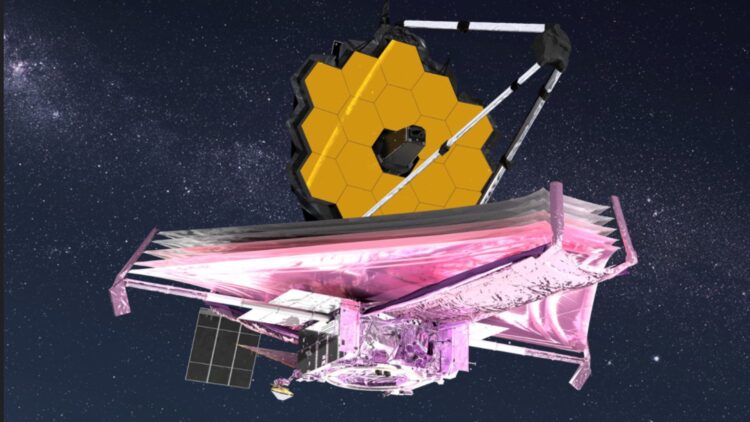
Does it sound familiar to you the name James Webb? Maybe you’ve heard about it because it’s a very important telescope scientists use on its missions. Recently, this telescope and the Hubble have confirmed the universe is expanding in two different directions. I know it is difficult to believe, even scientists doubt it at first, but telescopes have proved it. So, let’s find out more about what the James Webb Space Telescope and the Hubble telescope have found.
The expansion of the universe
To make this scientific explanation more visual, imagine you draw small dots on the surface of a deflated balloon and then you blow it up. What do you think will happen to the dots? Exactly! They will be far from each other because the balloon stretches.
So, this is what happens with the universe. Galaxies separate because space itself is expanding, and the speed this is occurring is called: the Hubble constant. You may not know this, but this is so important that it helps us know the age and destiny of the universe.
Measuring the expansion
Now, let’s go with the mystery!. Astronomers have two main methods to measure this expansion:
- The cosmic microwave background (CMB): This is the “first light” of the universe, a faint glow left over from when the cosmos was only 380,000 years old. The European Space Agency’s Planck satellite studied this radiation and calculated an expansion rate of about 67 kilometers per second per megaparsec. (One megaparsec equals 3.26 million light-years—an enormous distance.)
- The cosmic distance ladder with Cepheid stars: Cepheids are stars that pulse like a cosmic heartbeat: the brighter they are, the slower they pulse. By studying their brightness, astronomers can calculate their distance. With those distances, and by observing how their light is stretched (or redshifted), they calculate an expansion rate of about 74 kilometers per second per megaparsec.
The thing is that they should coincide, but they don’t!
Is it an error or new physics?
In the beginning, some astronomers thought the Hubble telescope could have made a mistake because the Cepheid stars were mixed with other stars. However, in 2023 the James Webb Space Telescope joined the mission, since it has a more precise infrared vision, and it confirmed the Hubble was right.
In 2025, a new study, in which both telescopes were used, showed that more that 1,000 Cepheid stars appeared in several galaxies. The result was clear: there’s no measurement error, the difference between the methods was real.
What does this mean?
If measures are right, then the James Webb and Hubble telescopes are not the problem, but how we understand the universe. This means that maybe:
- Dark energy, the mysterious force speeding up cosmic expansion, might not work the way we think.
- Einstein’s relativity could need adjustments on very large scales.
- Or there might be new physics waiting to be discovered—unknown particles, forces, or cosmic ingredients.
Importance of the James Webb
This telescope is not just taking cool pictures of galaxies and nebulae, it’s also become a cosmic detective. Thanks to its precision, now we know the Hubble Tension is a real mystery. For science, this is very exciting because when they discover a contradiction it means they are closer to finding out the new physics.
Instead of being bad news, this is exciting: it could lead to the next big revolution in science. Thanks to James Webb, we’re closer than ever to uncovering the universe’s hidden truths. Who knows what scientists will find next? What we know for sure is that we will hear news from the universe because in the next study, researchers will find something new about it. And I’m sure the James Webb will be involved in this next discovery.