
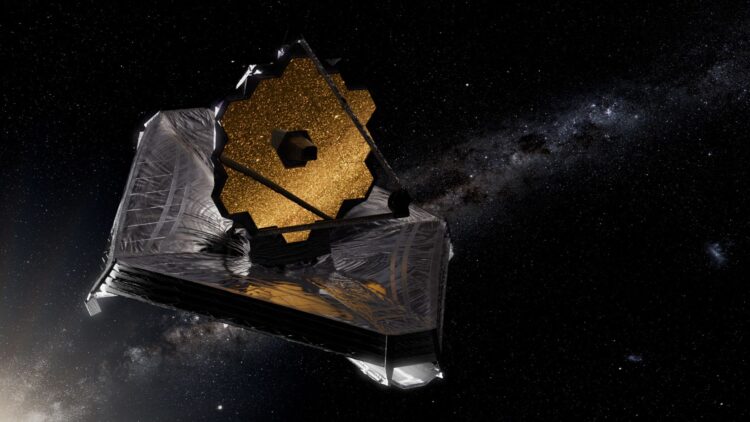
A single photograph has turned the night sky into a cosmic crowd shot… well, 10,000 of them actually. The James Webb Space Telescope (JWST), working in tandem with the veteran Hubble, has delivered an infrared panorama so dense with light that counting the galaxies feels like tallying sand grains. Yet the real star isn’t the number, (impressive as it is) but a glittering knot of galaxies that appear to be weaving themselves into one of the universe’s gigantic metropolitan hubs.
The numbers that set records
Dubbed the COSMOS-Web field, the mosaic covers 0.54 square degrees (two-and-a-half full Moons) stitched from over 10 000 JWST exposures. Computer vision tools have already tagged about 800 000 individual galaxies and a staggering 1 678 distinct galaxy groups, the richest harvest ever published in a single survey.
Near the frame’s lower centre, Webb spies a golden-white cluster whose starlight began its journey 6.5 billion years after the Big Bang, when the universe was scarcely half its present age.
Creating the image was intergalactic Tetris. Webb’s Near-Infrared Camera (NIRCam) hopped across the sky in 12 × 9 tiles, each slightly offset to cover detector gaps. Back on Earth, the COSMOS-Web consortium coaxed 40 terabytes of raw data through pipelines that scrub cosmic rays, align star fields to milliarcsecond precision, and balance colour so that cooler stars glow ruby while hotter ones lean teal.
Finally, engineers laid Hubble’s optical data on top, adding short-wavelength context that Webb cannot see. The result is a wall-sized canvas where galaxies at 500 million years after the Big Bang sit in the same frame as foreground spirals less than 50 million light-years away.
A city forming in deep time
That eye-catching, gold-tinted knot is a galaxy cluster weighing several hundred trillion Suns. X-ray maps from ESA’s XMM-Newton reveal hot gas trapped in the cluster’s gravitational grip, while Webb resolves individual member galaxies swirling like fireflies around a porch lamp. Clusters like this are cosmic laboratories: more than half the galaxies that exist today live in similar structures. By measuring how fast this cluster pulled itself together, astronomers can reverse-engineer the dark-matter scaffolding that built the modern universe.
Standard ΛCDM simulations predicted a sparse early cosmos; Webb disagrees. In the first 2 billion years, the survey finds roughly ten times more low-mass galaxies than models allow.
Some researchers argue dustier star-forming regions make those galaxies look brighter; others think we may need tweaks to dark-matter physics or to the recipes that convert gas into stars. Either way, the mismatch is a scientist’s dream problem, forcing new theories rather than rubber-stamping old ones.
Life behind the pixels
Graduate coder Anya Malik christened her alignment script “mosaic-tetris”. At 02:57 a.m. one April morning, her Slack ping lit up: Tile 432 matched, RMS error 0.004″. Across the globe in Santiago, team-mate Luis Robles replied with a GIF of fireworks. Over eight weeks the pair checked thousands of residual plots, each cluster of green dots a tiny victory against misaligned starlight. “When the final composite loaded, we zoomed in and got lost”, Malik says. “Every click was a new rabbit hole of galaxies.”
Webb’s spectrographs will now dissect the cluster’s brightest members, reading chemical barcodes that reveal when their stars were forged. The Vera Rubin Observatory, set to start its ten-year movie of the southern sky in 2026, will layer time-domain data on top of Webb’s deep still-life, catching supernovae and black-hole flares inside the very galaxies Webb exposes.
Farther ahead, ESA’s Athena X-ray telescope could chart how hot gas sloshes through the cluster’s dark-matter halo, testing alternate gravity theories.
Galaxy clusters are natural particle accelerators, magnets for dark matter, and signposts of cosmic history. Understanding how they assemble helps refine the cosmic distance ladder that GPS satellites and climate models indirectly rely on.
The open-access COSMOS-Web viewer also turns the public into collaborators: high-school students can flag oddball arcs that might be strong gravitational lenses, while citizen scientists using only a web browser have a shot at co-authoring peer-reviewed papers.