
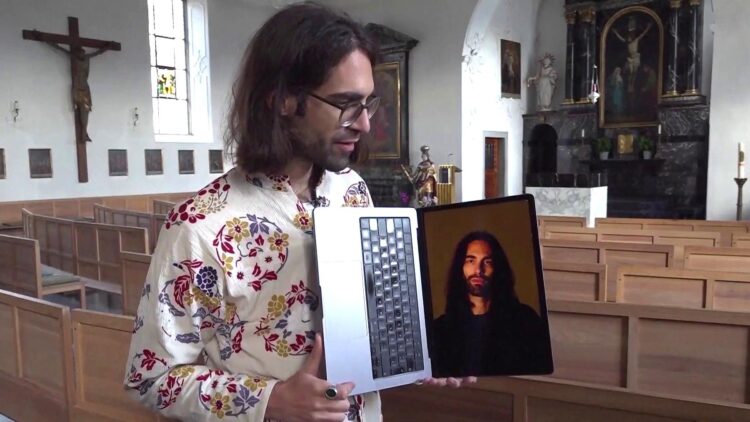
Faith, religion, and technology have come together in such a unique way. It happened in Switzerland, where a church decided to experiment with a ‘’holographic Jesus’’ creed by artificial intelligence. In the city of Lucerne, inside the oldest church, people can experience a mix of faith and technology in a way nobody has ever seen. So, let’s find out more about this combination.
Holographic Jesus
Inside the Chapel of Saint Peter there’s a holographic Jesus created by artificial intelligence inside a traditional confessional, where people normally speak privately with a priest. However, this time, the person going to the confessional finds this ‘’digital Jesus’’ that can speak more than 100 languages.
This idea is called Deus in Machina and it was created by the chapel together with the Immersive Realities Lab at HSLU. The goal is not to replace real confessions or act as a religious authority, but offer people a space to reflect through a mix of digital art, religious symbolism, and advanced technology.
Every person receives a warm greeting, and the environment is still private as it has always been. The only thing that changes is that you will have a conversation with a hologram, not with a real person.
Faith and technology
This idea combines two very different elements: a traditional space full of religious meaning and a digital hologram coming from artificial intelligence. This combination aims to make people reflect about how technology is changing even places considered sacred.
Although the hologram is not meant to be a real religious figure, its responses are thought to accompany moments of personal reflection. Until now, it has stayed close to the church’s theological perspective. Still, because it is an algorithm-based system, it is possible that someday it could give unexpected answers.
Debate
This holographic Jesus has received many different reactions. Some people feel curious about it and are drawn to this new way of interacting with faith. They think it’s interesting that the religious experience can combine with modern technology and become something different, visual, and surprising.
However, other people feel uncomfortable or even think it’s inappropriate. For some of them, the holographic Jesus disrespects faith and makes religion seem less serious. On social media, there are varied opinions: from jokes and funny comments to harsh critics and frustration.
But, this holographic Jesus also makes people wonder some important ideas:
- Can artificial intelligence offer emotional support?
- Should technology be part of a sacred place?
- Who is responsible for what a machine says when the topic is spiritual?
- What limits should exist when algorithms interact with religion?
Not replacing faith
Just to make sure everything is clear, the holographic Jesus is not created to replace rituals, priests, or traditional religious practices. Its purpose is to look at spirituality from a new angle and show how technology might exist alongside sacred experiences without taking their place. The installation is meant to spark thought, reflection, and conversation about what the future of religion might look like in a world where technology is everywhere.
So…
Who would ever think that a hologram of Jesus powered by artificial intelligence could be part of an old confessional? Sure, artificial intelligence is all over the world and is being used in many sectors, but now it is getting a big role in faith to think about the connection between humanity, technology, and what people consider sacred.
With every innovation comes good and bad opinions, but we should get used to the presence of technology in places we thought it wasn’t necessary. Now, what’s your take on this experiment? Would you be okay talking to a holographic Jesus?