
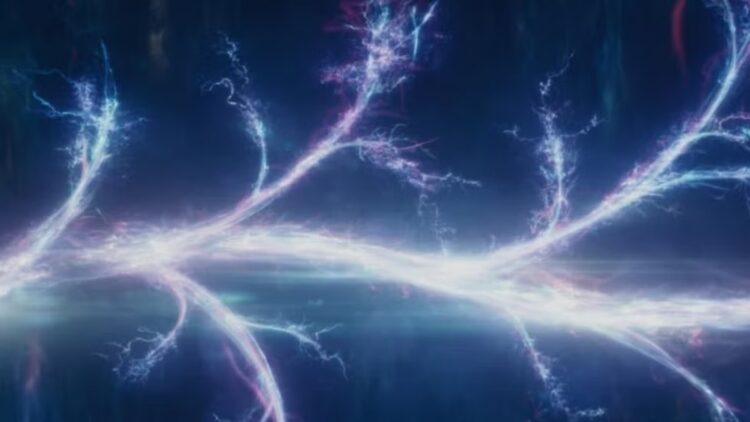
What if time had three dimensions? That is the theory proposed by scientist Gunther Kletetschka from the University of Alaska Fairbanks. Time is not a straight line but a three-dimensional structure, something like Marvel’s timelines, but with only three structures, and from these structures would emerge the space we perceive and matter.
It sounds crazy, right? New, above all, but if you think about it, the scientist might be right, and in that case, the universe would not be “made” of space but of time that folds, crosses, and intertwines to give shape to everything that exists and that we know.
Many are already comparing it to Einstein’s relativity and what it meant more than a century ago, but we are going to explain everything so you have no doubt about this theory.
Time as the basis of everything
According to Kletetschka, physical phenomena (from the movement of planets to the smallest particles) do not occur in space but within a kind of three-dimensional temporal matrix, along an axis.
And each axis of time would interact with the other two, creating the effects we interpret as movement, mass, or energy. If this theory were true (we will not find out for now, of course), it would explain much more precisely why particles have the mass they do, and we could get closer to the “theory of everything” that physicists have been pursuing for decades.
An illusion of time?
Einstein taught us that space and time are connected, that they form a single fabric. But Kletetschka takes that idea further and says that space is not fundamental, but rather a kind of illusion, a way of perceiving the three-dimensional structure of time.
It sounds strange, we know, but if space is only a consequence of time, then things we believe “expand” or “appear out of nothing” (like the universe itself) could finally have an explanation. They would be effects of time in action, not spatial phenomena.
So, instead of thinking that the universe floats in space, we would be inside a giant temporal process (like a braid) that never stops transforming.
What this theory would imply
Well, imagine it, it would change everything we know now. If three-dimensional time allows describing how particles, forces, and matter emerge, we could finally unite relativity and quantum mechanics, the two great theories that still contradict each other today.
And of course, understanding how time “works” at this level could open the door to new technologies for travel, communication, or who knows. A true revolution, indeed.
A new paradigm in motion
For now, the scientific community calls for caution (as always), but Kletetschka’s work has already been published under the title “Three-Dimensional Time: A Mathematical Framework for Fundamental Physics” and it has sparked debate across the scientific world.
Many believe it is a great opportunity to explain the contradictions of modern physics, and if it is ever confirmed, the name Kletetschka would stand alongside names like Newton or Einstein.
Three timelines that would mean time does not pass but surrounds us, and that we do not measure it, but live inside it.
If Kletetschka is right, the space we see, the planets, the stars, even ourselves, would simply be the tangible reflection of time moving in three dimensions. And it’s clear that to understand that new reality, someone is going to have to draw us a picture.