
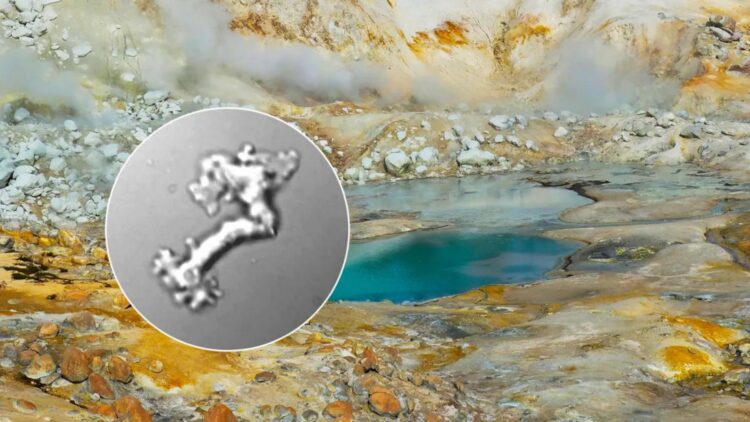
Science never stops surprising us, and where many times it seems that it no longer makes sense to keep searching, something new always ends up appearing. That is what happened to researchers at Syracuse University (United States) while they were investigating the volcanic hell of Lassen Volcanic National Park, and they found a living and active amoeba in a place where steam, heat and chemicals should not allow anything to live.
But there it was, curious, right?
It was in boiling water
While they were analyzing hydrothermal water areas, they saw that something was moving in the sample, what was it? What could be alive at those temperatures? And with those gases around, we are talking about a volcanic area!
Well, it was a eukaryotic amoeba, an organism with a nucleus and internal structure, what in scientific terms is called “complex life”.
Surviving in extreme conditions
The scientists expected anything except to see that the amoeba was not only alive, but that it divided and reproduced at 63 ºC. So we understand each other, from about 43 ºC, our human cells start to say “that’s it”. So it is truly shocking.
And what if they raised the temperature more?
At 70 ºC, instead of dying, the organism entered survival mode by creating a protective cyst and waiting for the environment to become habitable again. Its particular way of letting the “fear pass”.
A biological limit that has just been broken
For years, it was believed that no eukaryotic organism could go beyond 60 ºC, some fungus or algae could survive, but little more, but now we know that there are other organisms that also survive these temperatures.
According to the researchers, it is the first documented case of a eukaryote capable of withstanding such extreme temperatures without destroying itself from the inside.
And why does it matter?
Because it is something we did not know until it was discovered, it expands our concept of “extreme life”, something that until now had been dominated only by bacteria. And on the other hand, it suggests that complex life is much more adaptable than we thought.
In addition, there are new questions on the table because thanks to this we can investigate how life evolved on the primitive Earth, when our planet was a hostile place.
We think we know the Earth well… and suddenly an amoeba appears that laughs at our limits, and it does not close any story, but opens all the doors to new research.
And is there more?
Of course! Now that we like space so much and there are a thousand theories about what life up there could be like, think about it, if an amoeba can survive this level of heat on Earth, what about other worlds?
Planets and moons that were previously labeled as “uninhabitable” like Mars in the past, or places with internal heat like Europa or Enceladus, appear again on the map as possible habitable places for this type of amoeba.
It is not that we have found extraterrestrial life, but maybe now we will know how to look up there!
“We have searched in one direction, but there may be many more extremely resistant organisms that we have not yet found” Angela Oliverio, microbiologist at Syracuse University