
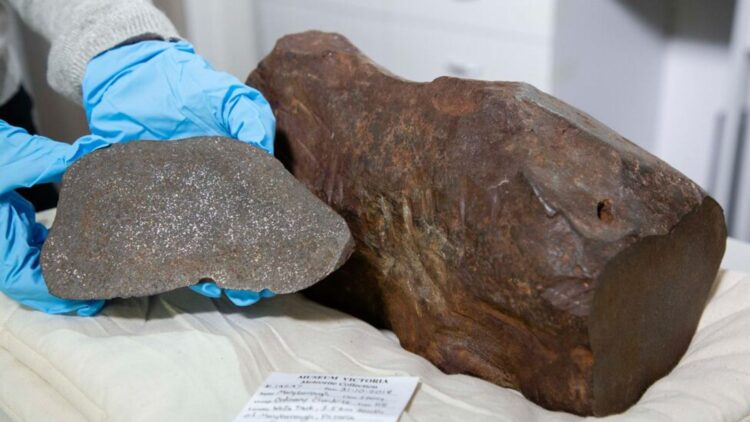
Ten years ago, David Hole was excavating in Maryborough Regional Park in Melbourne, Australia. At the time, he was searching for gold, but he never imagined that reality would be stranger than fiction, making him the protagonist of one of the most unexpected discoveries in modern geology.
While using his metal detector, he stumbled upon a large, heavy, reddish-coloured rock incredibly solid and difficult to break. Convinced that there was a gold nugget hidden inside, he took it home and tried everything to crack it open: a drill, acid, a hammer… but nothing worked.
So what was wrong with this rock? Why was it so impossibly tough? It was clear that there was no gold inside, but there was something even better: a meteorite!!
The Maryborough meteorite
Hole remained intrigued as to why he couldn’t break open the rock if it was supposedly nothing special (which, of course, he didn’t know yet). Determined to solve the mystery, he took it to the Melbourne Museum, where geologists Dermot Henry and Bill Birch made a discovery no one could have imagined:
The rock was actually a rare, iron-rich meteorite, an extremely unusual find, and only the second one these geologists had ever identified.
An incredibly rare meteorite
Weighing 17 kilograms (37.5 lb) and estimated to be over 4.6 billion years old, scientists described this meteorite as a time capsule containing materials that are even older than Earth itself, a truly unbelievable and unimaginable discovery.
Its composition was equally astonishing. The rock’s extreme hardness was due to the fact that it was composed almost entirely of iron, classifying it as an “H5 ordinary chondrite.”
Once they managed to open it, they also discovered crystallized droplets of metallic minerals inside, known as chondrules a rare and fascinating feature in meteorites.
When did this meteorite arrive on Earth and where did it come from?
Scientists still don’t know, but they believe that this meteorite may have been around 100 to 1000 years after the carbon dating test was performed.
Among the conjectures about the origin of this meteorite, it is believed that it could belong to the asteroid belt between Mars and Jupiter, and that most likely some collided with each other and then crashed into Earth. There are even records of sightings of fireballs in Australia between 1889 and 1951 that could coincide with its arrival. Scientist believed that this meteorite is rarest than gold, and even more precious, and there is a simple reason for believing this, it is one of the 17 meteorites that have been recorded in the Australian state of Victoria, and the second most massive chondritic (after one that was identified in 2003 that weighed 55 kg!!)
What and where is Maryborough?
Maryborough is a city located in the state of Victoria, Australia. It is well known because in the 19th century it was marked by the “gold rush”, thousands of gold seekers moved there to dig and collect gold from its land.
Why are meteorites special?
Because they are not just space rocks that wander through space, but rather they are like small remnants of space history. Depending on the fragment, they can offer very valuable information about the age and formation of the solar system, the processes of creation of the planets or organic molecules that are being investigated to see if they originate from life on Earth. As if they were time machines with very important information.
What seemed like just another rock has turned out to be one of the greatest geological discoveries of this century, and Hole, who was searching for gold, found something much better: a piece of space with millions of years of history. The clear idea that not everything that glitters is gold, it could be something better!