
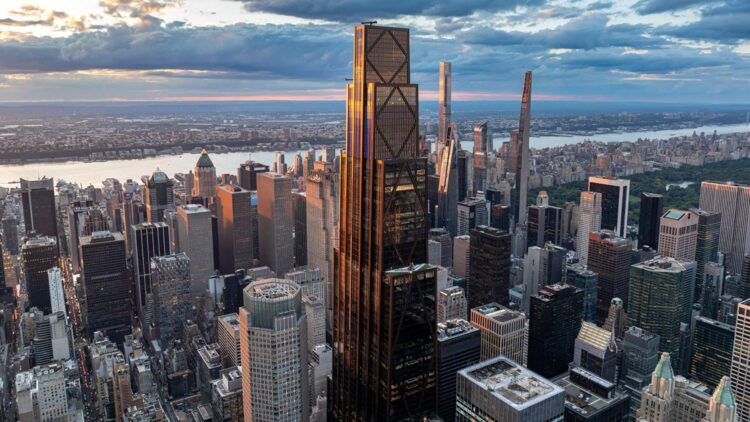
New York City is adding a new building, a new skyscraper in the heart of Manhattan. However, there’s a huge debate about it because some people see it as an ‘’ecological obscenity’’. That skyscraper is the new JP Morgan headquarters, designed by the popular architect Norman Foster. Even though the company ensures the building will work with “net-zero emissions,” many experts are concerned about the enormous amount of steel and energy used to build this giant tower. So, let’s talk a bit more about this new skyscraper in New York City.
The background of the new JP Morgan skyscraper
JP Morgan is one of the largest banks in the world, with operations in more than 100 countries. Last year, it reported weekly profits of over $1 billion, and its market value is far higher than other major U.S. banks like Bank of America, Wells Fargo, or Citigroup. Because of its enormous size and financial strength, the company wanted a headquarters that reflected its status.
In 2028, the architecture firm Foster + Partners won the competition to design the new building. To build it, the old Union Carbide building (built in 1960) was demolished, although it had recently undergone what JP Morgan described as “the largest green office renovation in the world.” Despite that renovation, the old tower was torn down to make way for a much larger, more modern structure.
A steel tower on Park Avenue
The new building is located at 270 Park Avenue, and one of the main criticisms is the enormous amount of steel used: about 95,000 tons. The architects say that 97% of the demolition materials were recycled, reused, or repurposed. Still, critics argue that this is an excessive amount for a building that is 1,388 feet tall (about 423 meters) with 60 floors.
To have a clear picture of this, this skyscraper uses 60% more steel than the Empire State Building, although the latter is taller and has more inner space. According to some critics, all that steel could “wrap the Earth twice.”
For this reason, the British newspaper The Guardian described it as an ‘’ecological obscenity’’. Even though it was presented as ‘’the city’s largest all-electric tower with net-zero operational emissions,” many experts consider this construction is opposite to all the sustainability promises. Norman Foster also designed the HSBC tower in Hong Kong, and it was once one of the most expensive buildings in the world.
Luxury and high-tech design
According to Jamie Dimon, CEO of JP Morgan, the tower cost about $4 billion. Regarding its design, the lower levels feature huge clusters of columns at each corner, creating wider sidewalks for pedestrians. Inside the main lobby is a 40-foot flagpole with an American flag, kept aloft by artificial indoor breezes.
The interior is made with impressive materials, including walls and staircases made from travertine stone sourced from a single quarry in Italy. For the more than 10,000 employees, the building includes:
- 19 restaurants with desk delivery
- A barber shop, gym, and meditation rooms
- A medical clinic and a pub
- Circadian lighting designed to improve productivity
Concerns about sustainability
Some engineers believe the building could have been built using way less steel. According to The Guardian, an engineer who analyzed the plans said that adding a few extra columns and shortening some spans by just a couple of meters could have reduced the building’s carbon footprint by 20–30%.
At night, the top of the tower lights up and can be seen for miles, making it a new landmark in Manhattan. But for many, it is also a symbol of the ongoing tension between ambitious architecture and environmental responsibility.