
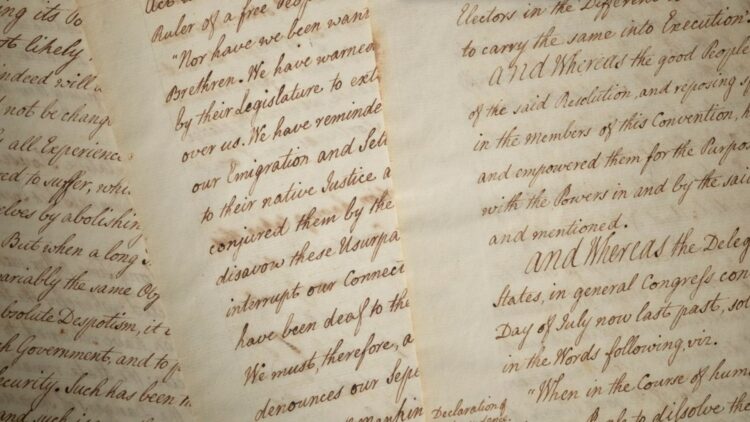
Treasures are not always found after hours and hours of archaeological excavations, and not in museums either, but in the places you least expect them… 100 dollars, a dusty book of laws about New York… And it turns out it’s a manuscript of the Declaration of Independence that could be worth up to 3 million dollars! It sounds like something out of a movie starring Nicholas Cage, but no, that’s what happened a couple of weeks ago. If you want to know more about this “storytime”, we’ll tell you about it below!
A discovery that changes everything
This book, which went unnoticed for centuries (since we’re talking about a document from around 1788). The anonymous collector who acquired it began to analyse its content, and, having doubts, decided to contact the Christie’s Auction House, where Peter Klarent (manuscript specialist and vice president of the bookmaker) confirmed the authenticity of the manuscript. Imagine the surprised faces of both of them when they found out that this manuscript is the only one in existence that is in private hands (that is, not in a museum), and that, in addition, it was written by a founder of the nation in the 18th century.
Samuel Jones, the author
That’s right, the manuscript belongs to the handwriting of Samuel Jones, a key lawyer in the history of New York, who is credited with having achieved the ratification of the United States Constitution.
Can this document be viewed?
For now, yes, it is on display at the Free Exhibition at Christie’s Auction House until January 23rd. Once January 23rd arrives, this document, along with other items from the collection about America, will be auctioned off. The venue is located at 20 Rockefeller Plaza and is open to the general public. Don’t miss the opportunity to see this wonderful document.
Interesting details about the manuscript:
This manuscript is the only known 18th-century manuscript in private hands according to the Harvard census of Declaration of Independence manuscripts. It is written on paper with the watermark “Curteis & Sons,” dated 1787, and contains notes by Jones and another unknown hand, which even refer to the independence of Vermont.
On top of everything, the document survived the passage of time in a modest blue law book printed in 1782.
Why is it important?
Because in these types of situations is when you realize that anything can be historical, as is the case with this Declaration, which has been passed from hand to hand for centuries without anyone paying special attention to it to realize that it is a key piece in the history of our country. In addition, all this opens up a rather interesting debate: should private collectors be able to own this type of item? If you stop to think about it, this document is unique and has incalculable historical value, and it feels like it belongs to all Americans (since it is part of our history), so it should be on display in the nation’s history museums.
Now the world is anxiously waiting to find out how much it will be auctioned off for and who will be the lucky winner to take on the difficult task of preserving this document in the best possible way so that it remains “alive” for as many generations as possible. This important treasure has once again brought national sentiment and the desire to learn more about how the country was founded to the fore. Who knows what else this document holds and if there is another similar one still lost out there?