
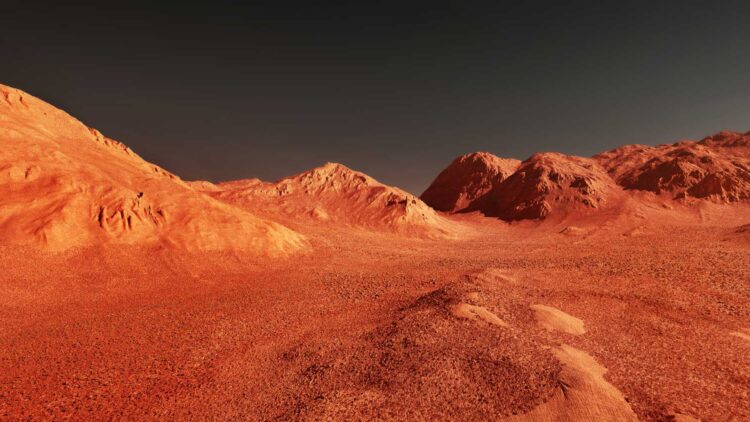
It was in the 1970s that NASA first revealed what the surface of Mars was like. It was the Mariner 9 orbiter that made it clear to us that there was once water on Mars. Since then, researchers have not stopped looking for more and more evidence that water existed on the red planet (and therefore, perhaps life?). A clear example of this is that the meteorites that arrive from this planet show that there is ice beneath the current surface of the planet, but they date back to more than 4.5 billion years ago!
Today, research is different. It is no longer about looking for water there, but about how long the Martian water lasted. And even more so, were there ever oceans? A team of scientists has just discovered that there is clear evidence of an ancient Martian beach that dates back 3 billion years.
Yes, as you read. Mars, the most arid and dusty planet we know today, may have had an ocean in its northern hemisphere. And the best thing is that this discovery is not just speculation: the mission led by Zhurong, from the Chinese Space Agency, has found solid evidence that points to the existence of a coastline that once covered the Martian surface!!
How did they come to this discovery?
We must first talk about the protagonist of the story: the Zhurong rover, a robotic explorer that landed on Mars in 2021, in a region called Utopia Planitia. This site was not chosen at random, as some previous studies had suggested that it could have been the bed of an ancient ocean.
But, of course, it is not that the rover found a sign that says “Beach on Mars.” What it really discovered were coastal sediments buried beneath the surface, using a technique called ground-penetrating radar. Basically, Zhurong was able to “see” what is under the Martian soil and found tilted rock layers in a way very characteristic of ancient coastlines.
If you’re wondering how we know these deposits were formed by an ocean and not something else, the answer lies in their tilt. On Earth, when an ocean drags sand and sediment to the bottom, it does so in a specific way: forming layers that tilt toward the water. Well, Zhurong’s data show exactly that same geometry on Mars.
What is Zhurong?
Launched by the China National Space Administration in 2020, it was named after a mythical god of Fire, and it just happens to be investigating the reddest planet in our system. It landed inside the planet and its job is mainly to detect areas that could be an ocean, or at least, areas where there was once water. This time, with data from the Zhurong rover, the debate takes a giant step forward: there is real geological evidence of a beach on Mars. This means that the planet could have held liquid water for longer than we thought. And if there was water… well, we already know what that means: possibilities of life!
Mars… more blue than red?
Everything indicates that in the Noachian period, Mars was a wet and dynamic planet, with rivers and lakes sculpting its surface. However, with the arrival of the Hesperian, the planet seemed to cool and dry, leaving behind canyons carved by catastrophic underground floods.
Mars has always been one of the great enigmas of our solar system, and little by little we are unraveling its history and learning about its past and what happened to it until we reach what we know. Each mission brings us a little closer to finally having someone set foot on the red planet.