
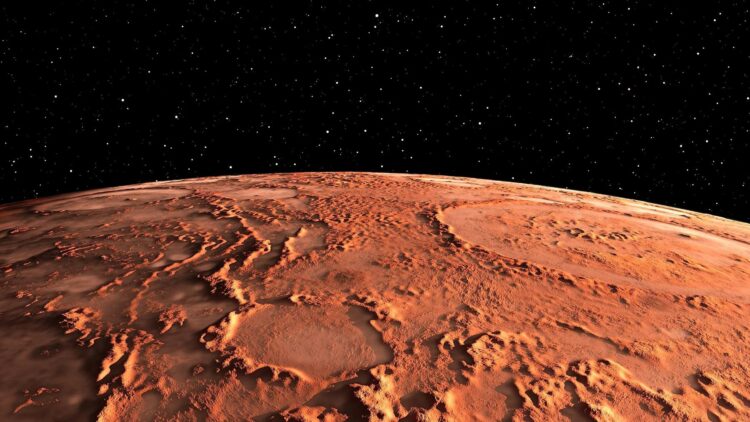
How many ways are there to get to Mars? For now, we know there are none, although NASA has spent decades wondering how to get there, its next planetary destination… But the distance that separates us from Mars (225 million kilometers) is too great and blocks any planning they do.
Between six and nine months is the minimum they are preparing to finally set foot on the red planet, but now there is a new proposal on the table, signed by Jack Kingdon from the University of California, and it promises to reduce the travel time to just 90 days! What? How? Keep reading and you’ll find out!
Finally getting to Mars
We don’t know how many years NASA has wanted to conquer the red heart of the solar system, but now Kingdon has arrived to change everything.
Based on real calculations and tools like the “Lambert problem”, Kingdon claims that ships like SpaceX’s Starship (yes, Musk’s) could cover the distance in much less time. The secret would be an in-orbit refueling system, what do you think?
Meanwhile, NASA is still betting on the development of nuclear engines to shorten travel… But this alternative is already generating debate and for good reason—if it works, it could literally be the catapult for space travel!
Two crewed ships, how?
Jack Kingdon proposes an operation with two crewed ships and four cargo ships, all of them fueled by prior refueling missions in Earth’s orbit. In total, 15 refuelings per ship would be needed, which means around 45 launches of the Starship Superheavy system.
It may sound massive (it is), but according to Kingdon, if SpaceX reaches its goal of performing up to a thousand launches a year as planned, the logistical deployment of this operation wouldn’t be impossible.
What are they going to use?
One of the strengths of the plan is that it doesn’t depend on experimental technology—in other words, there’s no need to manufacture things like nuclear engines or VASIMR thrusters.
The entire plan is based on systems that already exist (or are in an advanced stage of development). For the return from Mars, the idea is to produce fuel there using in-situ resources such as CO2 and underground water, through processes like electrolysis and the use of Sabatier reactors. It might sound a bit ambitious, and it is, but isn’t it amazing?
Less time in space, less exposure to risks
Reducing the duration of the trip means lowering the negative effects of space on humans: from loss of bone mass to increased risk of cancer from radiation… It also means less psychological strain, since being confined in a ship for over half a year is a long timeو imagine if you don’t get along with your mission partner!
NASA doesn’t see it clearly
The proposal has been welcomed by some sectors, but others point out that the operational load is excessive and that SpaceX has not yet proven capable of maintaining that launch rate.
This new proposal depends on optimizing current means and also aims to take advantage of the exact moment when Earth and Mars are closest to make the most of the trajectory.
But NASA wants to continue betting on the development of nuclear propulsion systems, which they consider essential for faster missions in the future.
A new way of looking at space
Maybe the most important thing about Kingdon’s study is not the 90-day figure (90 days to reach Mars, it just sounds too good!), but the idea that we don’t have to wait for the future to explore the universe—maybe we just need to use the tools we already have differently.
The debate is on the table, and with it, the possibility that humanity might finally dare to take the great leap to the red planet!