
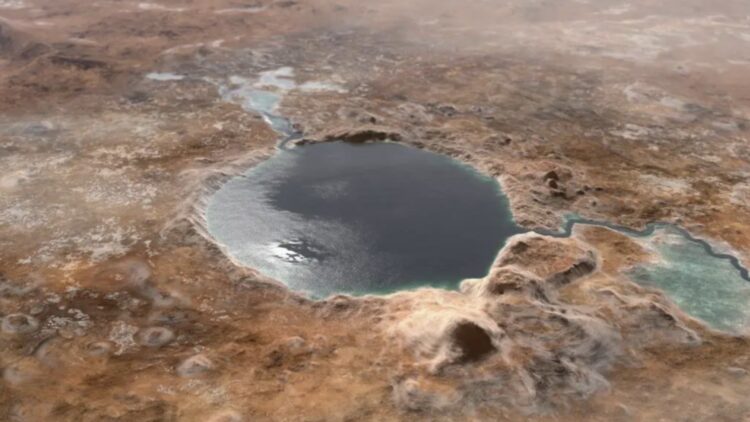
A new clue about life on Mars! NASA’s rover Curiosity has been exploring Gale Crater on Mars for years, with the aim of finding some clues showing the planet could once have supported life. Now, a new study published in Nature by scientist Edwin S. Kite offers a surprising explanation: Even though there was water, Mars may have made itself uninhabitable.
The data shows that carbonates—minerals formed when water and CO₂ interact—are more common than expected. This means that carbon dioxide (CO₂) was removed from the atmosphere, which made the planet colder and drier making Mars unable to support life. This is not the first NASA mission on finding water on Mars, so let’s find out more about this new mission.
Biggest space mystery
For many years, we have always heard or talked with someone about life on Mars. Thanks to several scientific investigations, it was proven the presence of water on the red planet, but how is it possible this planet has water and no life? Due to data from NASA’s Curiosity rover, scientists may finally be getting closer to an answer. And it is not what anyone expected.
A recent study suggests that Mars may have had brief episodes of water, but—ironically—it may have also sabotaged its own habitability through a natural chemical cycle. This discovery is forcing scientists to rethink what it really means for a planet to be “habitable.”
What scientists found
NASA’s Curiosity has been exploring the Gale Crater, a geologically rich region on Mars, since 2012. There, it found unusually high concentrations of carbonate minerals, which lead to a whole new theory.
Carbonates form when liquid water and carbon dioxide (CO₂) interact. Their presence means there was water, but also that something deeper was going on, making scientists come up with a fascinating idea: Mars may have had water, but every time it got a little warmer and wetter, it triggered a process that cooled it right back down.
Mars limiting itself
There is a process that scientists call “negative feedback loop”, a natural mechanism that shuts down any chance for long-term habitability every time conditions briefly improve. So, although water existed, it came and went too quickly for life to get started or evolve. To have a clear image of how this works, let’s explain this process:
- Increased sunlight caused surface ice to melt—liquid water appeared.
- Water and CO₂ reacted to form carbonates, which locked away carbon from the atmosphere.
- With less CO₂ in the air, the planet cooled down again.
- Water disappeared, and Mars returned to its dry, frozen state.
Carbonates
On Earth, active volcanoes release CO₂ back into the air, keeping the climate in balance. This process is different in Mars since it lacks active volcanism, meaning once the CO₂ was trapped in rocks, it stayed there. Instead of CO₂ escaping into space, it was quietly buried underground which is great evidence that solves a long-standing puzzle about Mars’ missing carbon.
Mars shows us that water alone isn’t enough.
This discovery also challenges how we search for life on exoplanets—planets beyond our solar system. Until now, astronomers have mostly focused on finding worlds with liquid water, when a planet also needs: a stable climate, geological activity to recycle gases, and millions of years of favorable conditions.
To truly find habitable worlds, we’ll need more than just telescopes that spot water or atmospheres—we’ll need to understand how each planet regulates its own climate. Basically, what Mars is trying to tell us is that water is not enough to create life, but stability is also crucial.