
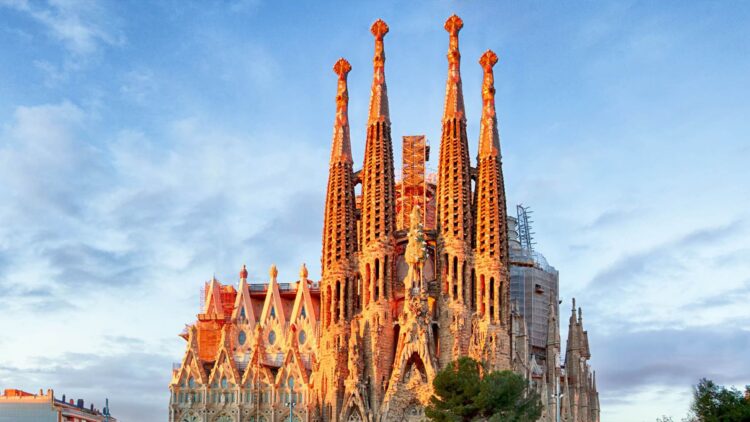
Barcelona has become one of tourists’ favourite destinations. And no wonder, it’s a magnificent city where art can be felt in every corner, having as its heart the famous Sagrada Familia, the Cathedral of Barcelona. Every detail of this incredible building is a whisper of history, faith, and art.
All of us who are passionate about art history will have in mind this impressive work by Antonio Gaudí, which, although unfinished, still inspires passion for art and architecture in everyone who dares to visit it.
However, many people overlook a small detail, a more scientific facet that not many expect, beyond its religious symbolism. On one of its facades, specifically the Passion façade, there is a “magic square.” A detail that goes unnoticed or many don’t understand, discreet but with a powerful meaning. How did it get there and what does it mean? Stay and read, and we’ll tell you!
From Ancient China to the Modern Age
You might not know what a magic square is, so we’re going to explain it in detail. It’s not a deformed polygon or any fantasy figure; it’s a numerical matrix, in other words, a table of numbers arranged in rows and columns so that the sum of each row, column, and main diagonal always gives the same result. That’s why it’s known as a “magic constant.”
Far from being a modern invention, magic squares have ancient roots. In Ancient China, India, and even in Islamic civilization, they were already used for mystical, astrological, or symbolic divine purposes.
One of the most famous examples in Europe is that of Albrecht Dürer, a Renaissance artist who included one in his work Melencolia I, where the numbers from 1 to 16 are arranged to always add up to 34, even in diagonal combinations or corner groups, something incredible.
Why is it in the Sagrada Familia?
After Gaudí passed away, sculptor Josep Maria Subirachs took over the work and worked on this façade for almost twenty years. Taking Dürer’s square as a reference, he modified it in a very special way to adapt it to the Sagrada Familia.
Does it have religious symbolism?
In the case of the Sagrada Familia, the magic square has a 4×4 structure. But the most curious thing is that although at first glance the numbers seem placed at random, when we add any of the rows, the result is always 33. And of course, this number is no coincidence, it matches the exact age of Jesus Christ at the time of his crucifixion.
The modification
If you’re wondering how Subirachs made the constant of the magic square turn out to be 33, many will say it’s simple but it has its complexity. He made a small change that makes it unique and different from the traditional magic squares. Normally they are whole, consecutive numbers until the table ends (for example, in a 4×4 square there are numbers from 1 to 16, and in a 5×5, numbers from 1 to 25). However, Subirachs took the liberty of modifying it and broke the rules: he removed two numbers and repeated two others. By eliminating 12 and 16, and repeating 10 and 14, he managed to always get the number 33.
It’s not the only detail.
The Sagrada Familia still has other details that make it (if possible) even more mysterious. When observing the repeated numbers and some combinations, you can read the initials “INRI,” the inscription that, according to the Gospels, was placed above Jesus’s cross (Iesus Nazarenus Rex Iudaeorum – Jesus of Nazareth, King of the Jews).
We don’t know for sure whether Subirachs designed this square with that intention, but, isn’t it quite a coincidence? Sacred art is full of codes and messages that reinforce its spiritual meaning, and this is one more example.
So, what now, ready to visit Barcelona?