
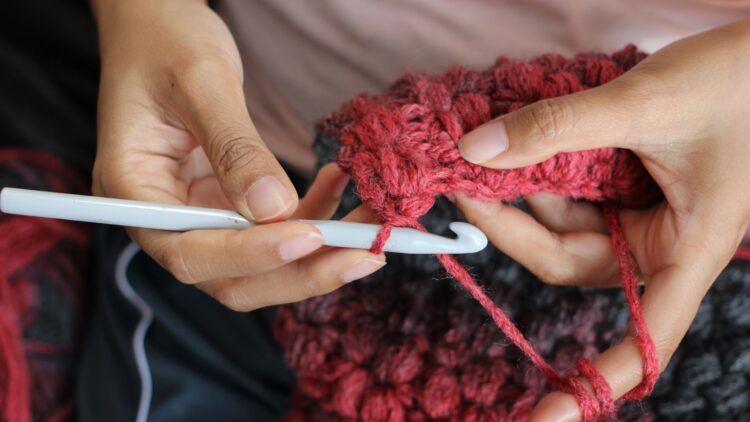
For those of us who are a bit awkward, crochet is a real challenge. It is not just about picking up a needle and yarn; it is something like patience, magic, and technique. Passing thread over and over, a knot here, another there, and what was once a simple thread ends up becoming a beautiful sweater, a cardigan, or a lovely scarf (or a disaster for those of us who, as I said, are useless at this). But anyone who has tried it will know that mastering crochet takes time, a lot of time, mastering techniques and repeating over and over.
Now, imagine that this skill could be used not only to make scarves or clothing but to solve mathematical problems. Specifically, one that has been puzzling minds for 40 years!
The protagonist of this achievement is Susanna Heikkilä, a Finnish mathematician who has solved this incredible problem through crochet. Here is how this happened.
A thread that connects crochet and mathematics
Forty years ago, a problem was formulated, and for forty years, it remained unanswered, until Heikkilä, in collaboration with another professor, Pekka Pankka, managed to classify quasiregularly elliptic varieties in four dimensions, thus answering a question posed by Misha Gromov in 1981.
How did she do it?
To achieve this, Heikkilä crocheted a sphere and used a chessboard fabric in her thesis defense so that abstract geometric concepts could be visualized to support her theory.
What was the problem?
In 1981, Misha Gromov, winner of the Abel Prize (considered the “Nobel” of mathematics), posed a question about the existence of certain geometric mappings in higher dimensions.
For decades, no one was able to fully classify these structures until Heikkilä and Pankka succeeded in 2025.
This problem belongs to the field of differential topology, which studies the shapes and spatial structures that can be deformed without breaking or losing key properties.
What are quasiregularly elliptic varieties?
They are mathematical structures that can be deformed under certain rules without losing their geometric essence. They are fundamental in geometry because they help understand how spaces behave in higher dimensions.
Before Heikkilä’s work, in 2019, mathematician Eden Prywes demonstrated that some varieties could not be quasiregularly elliptic. However, no one had identified which ones were until Heikkilä and Pankka completed the classification in 2025.
The secret behind the discovery
Heikkilä’s work is based on De Rham cohomology, a theory that allows analysing the shape of spaces using mathematical analysis tools.
In simpler terms for those of us who are not physicists or mathematicians, the research showed that quasiregularly elliptic varieties meet a specific algebraic condition, which allowed them to be fully classified.
According to Pankka, if a closed variety is quasiregularly elliptic, its intersections must be representable in Euclidean space.
Why did they use crochet?
Because crochet allowed them to create structures that represented the curvature of mathematical spaces, and the chessboard fabric showed how these mappings behaved.
By visualizing this work, other mathematicians and students were able to understand this complex process.
The model illustrates what is known as the Alexander mapping, a transformation that maps a plane to a sphere. When the grid is curved around the ball and the correct colours are sewn together, gaps appear between the squares, showing how space deforms under these mathematical functions.
Modern mathematics
It is clear that Heikkilä’s thesis is a historical milestone in Finnish mathematics, as she is one of the few people to have published a paper in the Annals of Mathematics, one of the most prestigious mathematics journals in the world.
Of course, this discovery could have applications in other areas such as geometry.
It seems incredible that 40 years of uncertainty have been resolved through something as simple and close at hand as crochet!