
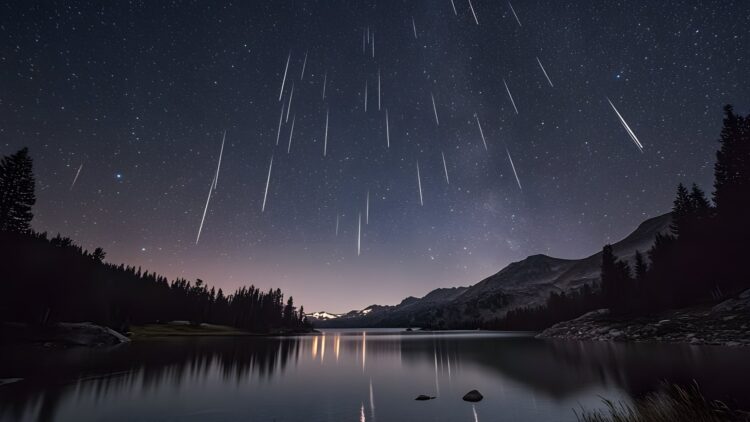
The night sky is something that fascinates many of us. Looking up and seeing hundreds of flashing points that could be very ancient universes, being aware of how small we are in the world and how big the galaxy we are in is… But when that sky starts to rain stars, oh!
They say that when you see a shooting star cross the sky, you have a second (which is magical) to make a wish. It is a moment when the universe seems to conspire in your favour. Meteor showers lend us that magic multiplied by hundreds, illuminating the darkness with flashes that seem to whisper stories of comets and distant galaxies… If you have ever wanted to stop time and connect with the cosmos, this year is packed. 2025 promises to be an unforgettable year, with nights in which the sky will become a blanket full of future wishes. Below we tell you everything you need to know about meteor showers, think about your wishes so you don’t get caught off guard!
Wait a minute… what is a meteor shower?
This is what it is called when thousands of dust particles and space rocks enter our atmosphere. Normally, these “remains” belong to comets or asteroids that have been wandering through space. When they enter our atmosphere at high speed, the particles heat up and burn, generating a light that humans perceive as small seconds that illuminate the sky. Although they seem to illuminate the sky, it is the result of the friction of these comets with our planet. Any night is a good night to wait looking at the sky, but there are specific dates when the sky becomes a real festival of lights.
Why do meteor showers occur?
They occur when the Earth, in its orbit, passes through streams of particles left by comets or asteroids. They are known as “meteoroids” and they break off from a comet when it approaches the sun. There are three steps that meteoroids go through to become shooting stars: the sun evaporates and separates the comet particles, but these remains remain in space, continuing the comet’s trajectory. Then, it is the Earth that gets in the way of this trail, causing these particles to enter the atmosphere at high speed (between 11 and 70 kilometres per second!). Finally, the particles dissipate (they do not end up like the star in Stardust). So, yes, our atmosphere protects us from being hit by pieces of other space elements and vaporizes them!
What are the most notable meteor showers?
Every year, the Earth passes through certain areas of its orbit that make these meteors more visible. These are the following:
- Quadrantids: magical nights in the middle of winter. They are located closer to the constellation Ursa Major, and up to 100 meteors can be seen per hour. You can see them until January 16.
- Lyrids: especially visible in the northern hemisphere. It is not the most abundant meteor shower, but it does stand out for its intensity. You can see them from April 17 to 26, with the 22nd being the day of maximum visibility of these shooting stars.
- Eta Aquariids: does Halley’s Comet sound familiar to you? The Eta Aquariids are its legacy, and it can reach up to 50 meteors per hour, especially visible to those who get up early (because it occurs at dawn). You can see them from April 20 to May 21, and their maximum splendour will be on the nights of May 3 and 4.
- Perseids: everyone’s favourite, also known as “the tears of Saint Lawrence”, originate in the constellation of Perseus, and are very special because they are enjoyed in summer, a night on the beach or in a mountain, and enjoy. These occur between July 17 and August 23, and the peak of these “tears” will occur between August 10 and 13.
Other meteor showers:
There are also other showers that are less “famous” but also worth observing
- Delta Aquariids (July 18-August 12)
- Alpha Capricornids (July 12-August 12)
- Orionids (October 2-November 12)
- Southern and Northern Taurids (October 13-November 27)
- Leonids (November 3-December 2)
- Geminids (December 1-21)
- Ursids (December 16-26)
Can you give us any advice on how to enjoy this meteor shower?
Of course! First, find a dark place far from the city, perhaps a beach where there are no lights or a meadow where there are no streetlights or any kind of light. Wrap up warm, because it usually gets cool at night. Find a comfortable seat, a blanket on the ground and wait looking at the sky. Don’t be in a hurry, they will appear when you least expect it.
And, it may seem silly, but check the weather and the phase of the moon you are in, the sky has to be clear and, if the moon is full, you will probably see more because the brightness of the shooting stars is lost in the glare of the moon.
Astronomy lovers, you’ve been warned! You can’t miss any of them!