
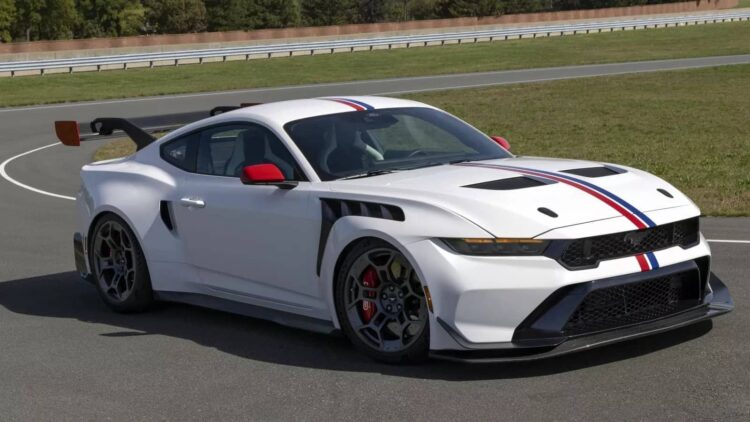
The Mustang GTD gets into the Nürburgring top 10 thanks to 3D printing. Ford has managed to make the 2025 Mustang GTD stop the clock at 6:52.072 at Nürburgring!!! Getting into the Nürburgring top 10, meaning it enters among the ten fastest cars in history on the German track.
To give you context: it is six seconds faster than the Ferrari 296 GTB and only three seconds slower than the Porsche 911 GT3 RS, wow, Ford! The key, according to Ford, was the use of 3D printing to adjust the aerodynamics right where everything was at stake, on the track. And we are going to tell you everything.
A lap to remember
It was this past April when the GTD stopped the clock with an incredible time for this vehicle, nobody could hardly believe it. At Nürburgring, which is where the true level of the great sports cars is measured, that record consolidates the Mustang as a direct rival of the European elite!!
3D printing
The big surprise came from the way Ford faced the fast lap: taking advantage of 3D printing to design and test aerodynamic parts directly on the track. The engineers were adjusting elements almost in real time until they found the ideal configuration.
The clearest example was the hood flicks, small additions on the hood vents that helped redirect the flow and give the front axle the extra downforce it needed.
Stability without losing speed
From the start, the GTD already generated more than 590 kilos of downforce at 250 km/h. 3D printing allowed that balance to be adjusted without sacrificing the top speed, which remains at 202 mph (325 km/h). But it needed more support on the front axle to be stable at high speeds without losing its top of 202 mph (325 km/h). That is where the printed parts came in: they gave more downforce but kept the same drag coefficient.
Just enough to go under seven minutes
Goodall explained to the media that without those modifications, the lap under seven minutes would have been “very tight”. They tested several versions of the parts, and once they found the ideal one, they took it to the wind tunnel in Detroit to validate the design.
The GTD thus combines the best of 3D printed adjustments with technologies already present in the car, such as the active drag reduction system and the extensive use of carbon fiber. A mix that allowed it to make history on the most demanding circuit in the world.
A different Mustang, but just as pure
Under the hood the V8 is still there, delivering 815 horsepower, nothing new. But beyond the number, the important thing about this fact is that the Mustang GTD respects the essence as always, a muscle car as always (even if it now plays in a league where the rivals are called Ferrari and Porsche). A complete reinvention, Mustang does not want to be left behind.
Is the future in 3D printing?
Well, what Ford did at Nürburgring is more than a sporting achievement, maybe 3D printing has already stopped being part of an experiment and is entering the real development of supercars.
Think about it, print a part, mount it and test it on the track right away, automotive engineering is on fire.
Beyond speed, it is technology, it is innovation, and we love it. Ford is putting its name back on the highest podium of technology.